
The alarm bells are sounding; manufacturing is disrupted by AI and jobs are disappearing. Headlines grip readers with troubling stories of layoffs and closures while often overlooking its power to unite data, people and institutions. Successfully implemented, however, AI increases speed, improves decisions, and leads to greater efficiency, accuracy and creativity.
Manufacturing is resilient having adapted to change before. CNC automated manual machining, CAD replaced manual drafting while ERP / MES supplanted Excel spreadsheets. Rather than displacing jobs, these advancements accelerated human involvement. Throughout these changes, manufacturing has adapted, survived and thrived.
While AI brings measurable efficiencies in pattern-recognition, analysis and documentation, humans apply decision-making and context. These advantages lead to more accurate reporting, faster quoting and better forecasting, to name a few. With shorter iterations between design, quoting and supply chain, manufacturers become more efficient.
Harnessing AI keeps people at the center while enabling businesses to build a competitive advantage. Asking the right questions that challenge bias and assumptions is a key part of applying it properly. As a deep resource, it offers insights whether you’re a business analyst, research engineer, CTO or chairman of the board. Businesses ripe for adoption are SMEs, those with an aging workforce and skills gaps, but all can benefit from this new technology.
Most users of AI won’t need to build complex tools, rather, they will learn how to apply them to their advantage within their disciplines. We become AI literate versus an AI expert. The most valuable knowledge won’t be replaced by AI but applied by those who learn how to use it.
Academia plays an outsized role in the advancement of AI within business. The rapid ascent of AI has put academia on its heels as it tries to understand the technology while preparing students for professions. As knowledge increases, opportunities for applied learning should be offered first – solving the broadest skills gaps – before more advanced coursework is built around more complex AI models. Moreover, as the technology advances, transforming industry needs into academic pathways will be necessary.
Michigan has key advantages. It is unique in its deep industrial knowledge, academic training and legislative support which allows the adoption of disruptive technologies like AI. The inherent resilience mentioned above alongside substantial data captured over decades will serve as accelerators for AI’s adoption in manufacturing. Academic institutions in Michigan have been successfully training graduates in manufacturing principles over this period, and government can use its influence to not just keep manufacturing in Michigan but put in place mechanisms that protect businesses and the economy as we return respect to the livelihoods that the industry offers. All are poised to be force multipliers for AI in ways that will advance reshoring, supply chain, operational resilience and talent retention.
Businesses, academics and governments who are members of neutral, objective nonprofits, contribute to the ethical advancement and adoption of technologies like AI. These key institutions are leading the discussion through interactions at events like roundtables while offering SMEs key insights into the strategic advancement of technology through resulting publications.
They connect industry with academia, technology with workforce and strategy with execution. The ecosystem is built on the principle of uniting powerful forces to advance technology across the region. It’s likely then that industry leadership has asked itself questions like, “Should I adopt AI?” and “If so, where do I apply it?” A simple answer to these questions is where do I have the most friction today?
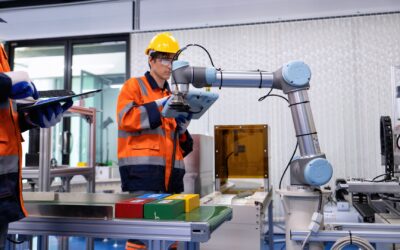
If you are wrestling with workforce retention issues on an end of line quality inspection, perhaps a simple vision system can address the problem. Maybe equipment maintenance unpredictability is compromising numbers – perhaps embedded sensors can help. A bottleneck may exist at an assembly point where a cobot may be the solution. For every problem, there is likely a solution that members specializing in technology can address.
AI shouldn’t replace employees; it makes the work they do more valuable. This translates to a more efficient and profitable organization. The future of business won’t be shaped by machines alone, rather, it will be shaped by workers who know how to work alongside them.
Dan Stewart is a Detroit-based business development professional specializing in relationship building using a personal face-to-face approach, currently working as a Relationship Manager at Automation Alley. Having spent decades working in automotive engineering and manufacturing operations, Dan understands the values that drive successful business development. Dan writes a frivolous blog, publishes a weekly newsletter, has numerous articles published in trade journals including SIA - The Staffing Stream, and has written and published “Managing The MSP” - a book centered on the proposition of building successful relationships with MSP’s in the contingent labor space. In addition to his extensive business development acumen, Dan is an accomplished public speaker. Dan holds a bachelor’s degree in business administration from Northwood University in Midland, MI.