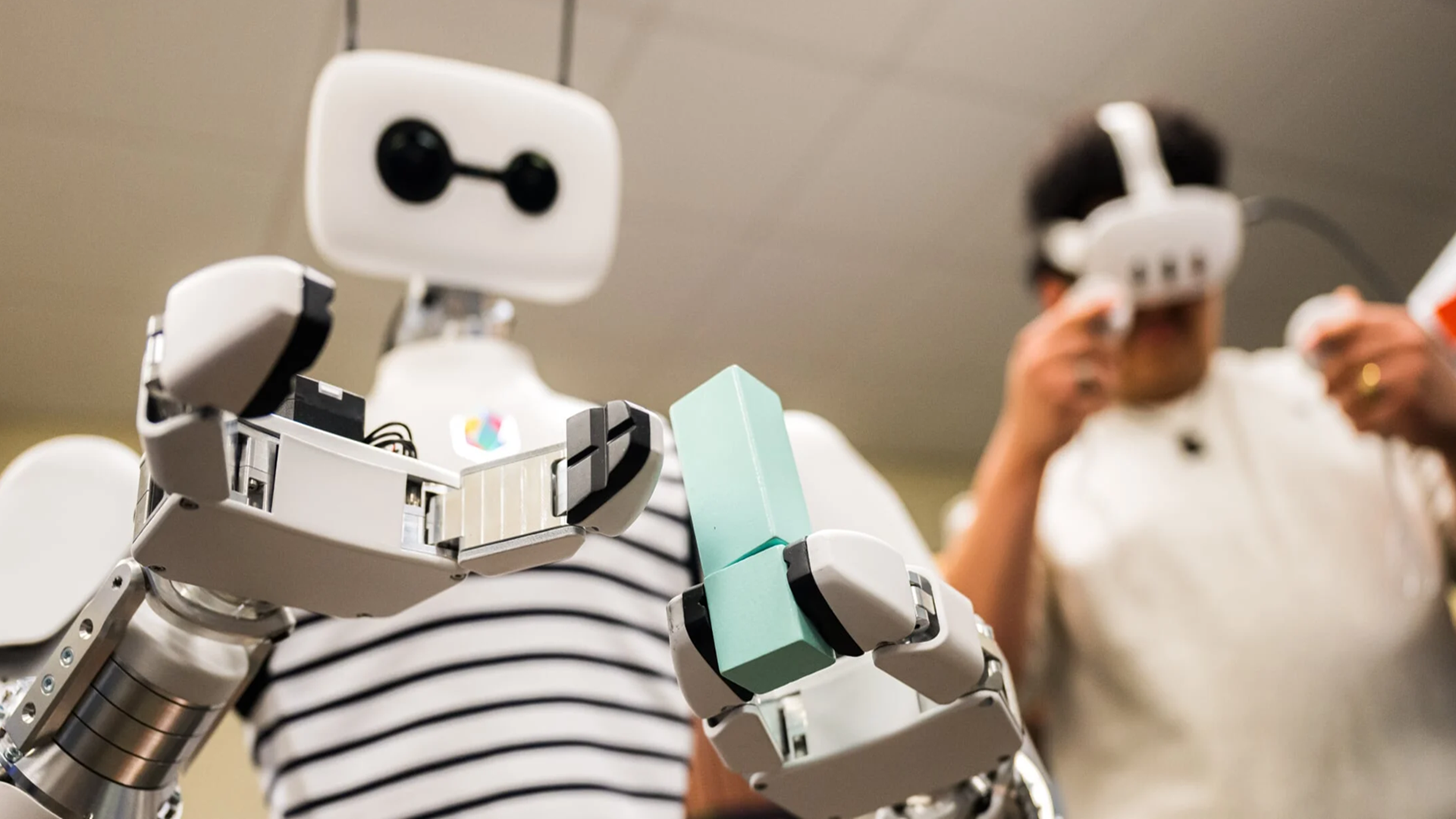
Inside Michael Walker’s Human-Robot Interaction (HRI) Lab at Michigan Technological University, the clinical atmosphere often associated with high-tech research is nowhere to be found. Instead, the air is filled with the low hum of motors and mechanical clicks along with enthusiastic conversation between student and faculty researchers.
At the center of it all is Reachy the Robot.
With an expressive head on a swiveling neck and gangly, bio-inspired arms, Reachy’s look, complete with its standard-issue black-and-white striped tank top, leans more toward endearing companion than sci-fi overlord. Walker chose to bring Reachy to Michigan Tech for that precise reason. In the new era of human-robot interactions, Reachy has the potential to make inroads with one of the oldest challenges in the robotics field: surmounting the uncanny valley.
The uncanny valley is the creeped-out sensation some people feel when interacting with an object resembling a human. It’s a highly subjective emotional response. As Walker explains, we tend to gravitate toward cute, rather than being drawn to something artificial that’s trying too hard to simulate reality. The uncomfortable, uneasy or repulsed feeling, which can also be triggered by photographs generated by artificial intelligence, is a hallmark of the uncanny valley.
And that presents a challenge, said Walker, an assistant professor of computer science. “The next phase of robotics will be in the humanoid space,” Walker said. “How can we make that experience more cohesive and welcoming?”
Read this article in full here.