
Behind the historic charm of many New England homes is an often-overlooked problem: their walls contain little to no insulation. That can make houses hotter in summer and chillier in winter. In some older homes, as much as 25 percent of heating energy is lost through the walls.
“If the US is going to meet its 2050 energy reduction and carbon emission reduction commitments, some 50 million homes are going to need a deep energy retrofit,” says Andre Sharon, a Boston University College of Engineering professor of mechanical engineering. “It turns out that actually insulating the walls in a cost-effective and nondisruptive manner to the residents is very challenging.”
He and his team are testing a potential solution: customized, highly insulated panels that can be added to existing walls with the help of augmented reality. The insulation system can quickly be installed by a team of two, potentially cutting a building’s heating and cooling energy lost through walls by up to 85 percent.
Sharon is the director of the Fraunhofer USA Center for Manufacturing Innovation (Fraunhofer CMI), a BU-based applied research hub that brings together students, faculty, and professional engineers to help American companies “solve their most difficult engineering and manufacturing problems,” according to its website. The center is part of an international network established by Germany-based research and development nonprofit Fraunhofer-Gesellschaft, which partners with universities across the world to bridge the gap between academia and industry. Fraunhofer CMI, which has been located at BU since its founding in 1994, specializes in pursuing innovation in sustainable energy, industrial automation, and biomedical systems.
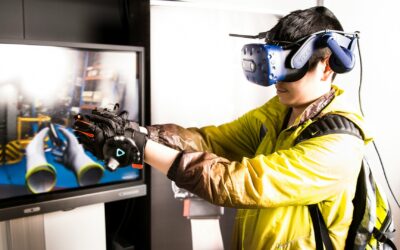
The team’s augmented reality (AR) approach to insulating homes combines both a software and mechanical solution. Using the system, engineers first laser scan a building, then analyze that scanning data to design and fabricate custom insulated paneling. At the job site, workers wear a virtual reality headset that uses AR to guide them through the installation process, showing exactly where each panel needs to go, reducing the need for time-consuming adjustments and on-site cutting. The project is funded by the Department of Energy.
Read this article in full here.
Fraunhofer USA, Inc. is a 501(c)(3) not-for-profit organization that bridges the gap between academic discovery and industrial innovation. Founded in 1994, we conduct applied research and development for industry, state governments, and federal agencies across the United States. Working closely with our founding partner, Fraunhofer-Gesellschaft—Europe's largest applied R&D organization—we combine German engineering excellence with American entrepreneurial drive to accelerate technological advancement.
Through our research centers, strategically partnered with premier U.S. universities, we specialize in advanced manufacturing, sustainable energy, artificial intelligence, software systems, and materials science. Our unique position within the Fraunhofer global network and our Strategic Partnerships enable us to leverage both domestic and international resources to enhance our R&D services. In an increasingly competitive global environment, we strengthen transatlantic collaboration in education, applied research, and innovation, helping organizations of all sizes bring new technologies to market and address critical societal challenges.