
In March I decided I needed answers about what makes AI recommend one company over another, real answers. Science grade answers.
My career was born in the crucible of SEO trench warfare. Since 2008 I’ve seen Google update its algorithm countless times, and each time watched the industry scramble to keep up — and make a few bucks along the way. Misinformation and outdated practices were rampant, and with the arrival of AI and GEO I could see it all happening again. Cue thousand yard stare.
To get to the grounded truth I started asking questions, forming hypotheses, gathering data, and then finally…
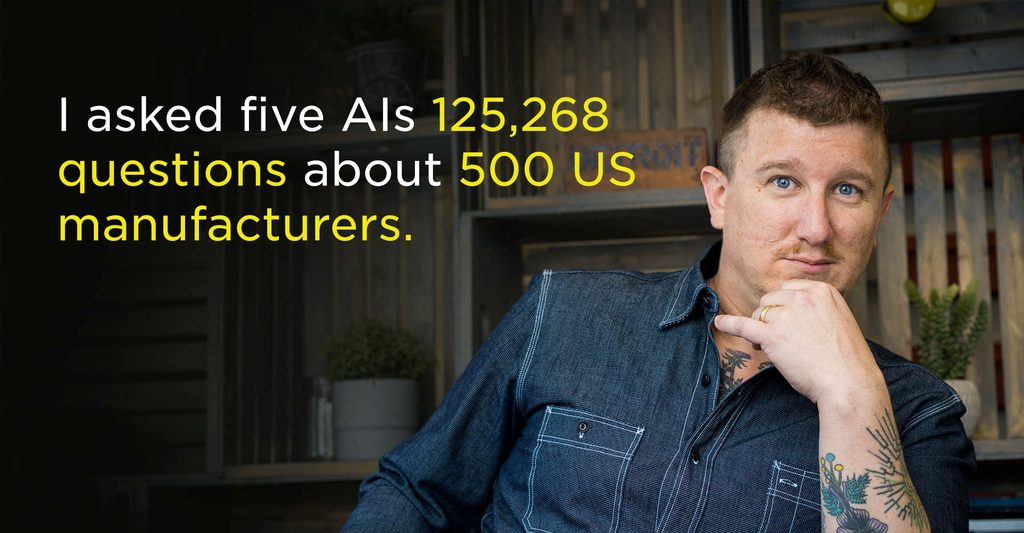
I asked five AIs 125,268 questions about 500 US manufacturers
Study methodology at a glance
- Collected sample set of midmarket manufacturers and built a profile for each
- Used profile data to generate niche specific prompts for each company
- On average each company got around 17 questions tailored to its profile.
- Every question was asked three times on five AIs.
- Asked five AIs 125,268 questions about 500 US manufacturers.
- From those answers we pulled out every company the AIs named: 52,082 of them.
- The average study company is named in about 8 of every 100 AI answers about its niche and state.
Who’s in the study?
Companies in the study range from job shops to tier 1 suppliers, doing everything from making fasteners to engineering advanced ceramics. Selection focused on midmarket companies, established but with an eye on growth. The companies for whom research like this could mean the most.
Firmographics
- 41 US States
- 60% Have <200 Employees
- 25-50M Avg. Annual Revenue
Top States
- Michigan
- Ohio
- Illinois
- Wisconsin
Top Niches
- Automation Integrators
- Automation OEMs
- CNC Machining
- Metal Fabrication
Which AIs were asked?
I asked the major players, minus Grok because it didn’t have the marketshare to be relevant. ChatGPT has the largest share of the market by a mile, with Gemini and Claude slowly catching up. Each one works differently, cites a different number of sources on average, and has its own source preferences.
The official list:
- ChatGPT (which powers CoPilot)
- Claude
- Gemini
- Google AI Mode
- Perplexity
What did the prompts look like?
Prompt templates varied by niche and were generated using profile data like certifications, capabilities, industries served, and location. This more closely simulates buyer language than prompts like “What is the best CNC shop in Ohio”. But I asked that too, just to see what it would say (more on that later).
Example Prompts
- “I need a CNC Machining company in NY that works with aluminum 7075”
- “Find me a CNC Machining company in WI with ISO 9001 certification that can do Swiss turning”
- “Which Automation OEM companies in OH specialize in automated storage and retrieval systems for aerospace applications”
- “I need a Plastic Injection Molding partner in MN that works collaboratively with customer engineering teams, not just an order-taker”
- “Which Metal Fabrication companies in CA can handle a project from engineering design review through painted and assembled weldments”
How did you evaluate a company’s website and web presence?
If how often a company is mentioned by AI is one half of the puzzle, this is the other half: how are they showing up online? The data collected falls into two buckets: on-site, and off-site. On-site data is about your website, off-site data is about everywhere else. Each was compared against the AI mention rate to look for any relationship between the signal and an increase in AI mentions.
Some of the data gathered is as follows:
On-Site Audit Datapoints
- Homepage page title, meta description, headings, word count
- SEO best practices
- Certification visibility (ie ISO:9001)
- Page presence: Services, Capabilities, FAQs, Industries Served, etc.
- Sitemap.xml and robots.txt presence
- llms.txt presence
- Structured schema presence and completeness
Off-Site Datapoints
- Domain rank
- Backlink profile and spam rating
- Google Business Profile
- Google SERP ranking
- Google organic visibility
- Brand mentions
- Paid search activity
What did I learn about AI visibility?
A lot. Way too much for one article! Below is an early look: four findings that reset some common assumptions, one thing you can do today to start improving your AI readiness, and the AI Readiness Score we built to show you where your company stands. The full findings, and your own score, arrive at the launch.
AI is not just naming the giants
Ask AI for “the best manufacturers in Ohio” and household names take about a third of the top spots. Ask for something specific, like a capability, a material, or a product, and those same names nearly vanish, down to 3-6%. A giant like GM gets named in roughly 1 or 2 of every 100 answers where it could have appeared. Some regional specialists hit 35 to 40. When the question gets specific, the specialist wins.
Asking ChatGPT once tells you almost nothing
Ask the same question twice and only about half the companies come back the second time. One answer, or one screenshot, is barely better than a coin flip. A company’s real visibility only shows up across many questions asked many times. That distance, between a single glance and a real measurement, is the reason this study exists.
AI learns about you from two places
When AI cites a source for an answer, 50% of the time it is a company’s own website. The next biggest share is business directories, making up 20% of citations. Together, those two are most of what AI draws on, and ThomasNet alone is the single most-cited outside source for four of the five AIs we queried. If you want AI to know something about your company, it needs to live on your site or in a directory (ideally both).
AI knows who you are, but recommending you is another story
Ask AI about a company by name and it will get the details right about 89% of the time. The inaccuracies often come from acquisitions, or companies with very similar or descriptive names. Think names like MetalFab, Metal-Fab, Metal Fabricators Inc, etc.
Ask AI who to hire and the average company is named in 13.5% of the questions designed with it in mind, and 8% across its whole market (niche/region). The first number is how likely you are to be cited when a buyer asks for exactly what you do; the second is how often you come up across the wider set of questions where most new relationships actually begin.
What can you start working on right now?
Of everything the study points to, one move is simple, high-impact, and entirely in your hands: claim your business directory listings, and make sure each one links back to your site. Start with ThomasNet, the directory AI cited most, then look at any niche specific directories or membership organizations you’re a part of.
Some other B2B directories that are good to cover:
The rest of the playbook comes with the report. This is the piece you can start on this afternoon.
Introducing the AI Readiness Score
AI assistants rarely name the same companies on any single question, but across thousands of questions they agree on one thing: who is visible and who is not. In other words, AI visibility is real, and it is measurable. But it’s not something that’s easy (or cheap) to do yourself with any accuracy, so we built a tool to measure what you can control: readiness. The beta version of the AI Readiness Scan will launch on November 12th, alongside the research.
AI readiness vs AI visibility
The distinction is subtle, but significant: visibility is whether AI names you, while readiness is how well your site matches what we found drives visibility. You can’t flip a switch on visibility, but you can get ready — and that’s what the score measures.
In other words, visibility is the outcome, and readiness is the input.
How do we get the score?
The AI Readiness Score rates factors in your website and web presence, each one weighted by how strongly it tracked with getting named in the AI answers to our research prompts. We did not choose the factors and scoring tiers by opinion, committee, or wishful thinking: we measured everything, kept only what predicted AI mentions, and let the data set the weights.
Four scoring tiers: from Invisible to Connected
The score places companies on a four-level scale, from Invisible to Connected, and the distance between the levels is significant. The average manufacturer in the study was named in about 8 of every 100 AI answers about its market. Companies at the top level were named nearly twice as often. Companies at the bottom, less than half as often. Four levels, and a four-fold gap in how often AI puts you in front of a buyer.
That is the idea behind the score: we know what factors go along with getting named at a certain rate, so a site that matches the same criteria should reach a similar rate in its own market. No gimmicks, no guessing games, literally just math. And it’s built exclusively for the manufacturing industry.
What’s next
The research officially launches November 12th with an event hosted by Automation Alley, you can get the details and register for the event here. We’ll walk you through the research, present our findings, take questions, and do some networking. You’ll walk away with links to the presentation slides, the full research report, and the AI Readiness Scan.