

Introduction
Aluminum LPDC EV battery housings are complex parts with rough, highly reflective surfaces, and they move through demanding steps such as air quenching, deburring, straightening, and long heat treatment cycles. These conditions can expose any weakness in identification, especially when codes must remain readable through surface changes and extreme temperatures. Ford and its supplier needed a direct part marking code that could be applied on this challenging material, stay scannable throughout production, and remain readable until the component was installed in the vehicle. In short, traceability could not break mid process, even when the part surface and condition changed.
Early trials with traditional 2D matrix codes showed the limits of contrast based marking on LPDC aluminum. In previous tests, matrix codes showed reading issues after the air quenching stage, and after a heat treatment cycle lasting more than two hours at high temperature, readability dropped to a level that was not acceptable for reliable tracking. This created a practical break in part level traceability and made it harder to maintain process continuity and data linkage across the full production flow.
Part 1
Ford and the supplier implemented Cosmodot’s CDOT Code for direct part marking in aluminum LPDC EV battery housing manufacturing and assembly. CDOT is laser engraved onto each part with a unique ID and remains readable on rough and reflective surfaces.

This matters in LPDC production because contrast based codes can be difficult to mark within tight cycle times on shiny aluminum, and reflections can reduce readability as parts move through downstream steps. In this flow, CDOT code readability is maintained from casting through final assembly.
Part 2
Heat treatment is one of the most demanding stages in the process, and CDOT codes continue to be readable after heat treatment cycles above 540°C or 1040°F for more than two hours. In addition to marking the housings, the identification layer also covers the handling infrastructure. Heat treatment baskets are tracked using metal ID plates that carry CDOT codes, and each cycle uses these codes to associate the basket with the battery housings it contains. This supports clear matching through heat treatment and strengthens control over the movement of parts through the thermal stage.
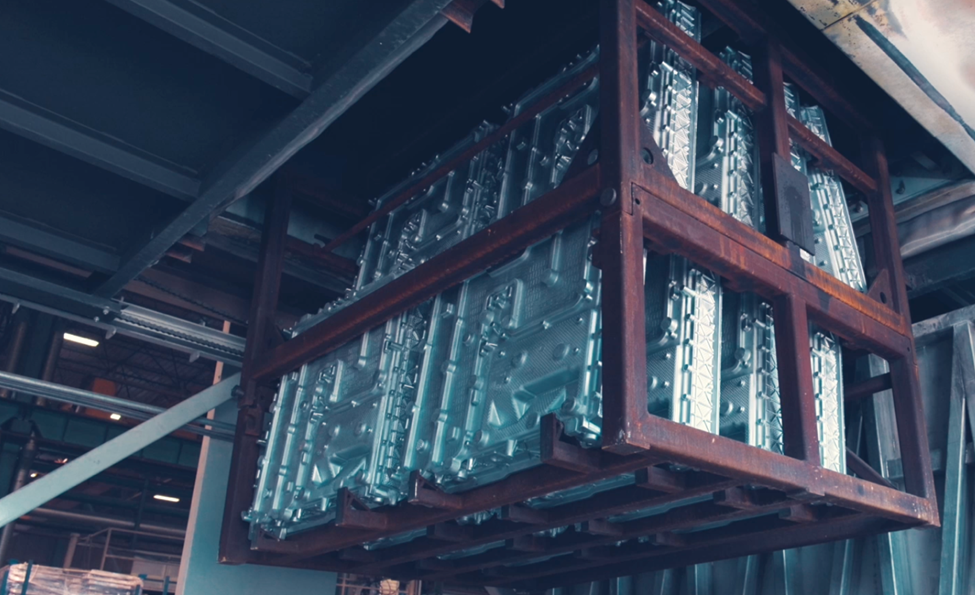
The CDOT coded battery housings are loaded into heat treatment baskets, which are also identified by a CDOT coded panel mounted on the side.
Once part identity remained stable, the supplier combined CDOT capability with its broader vision for data retention and quality tracking. Real time monitoring became practical because process data and machine values such as temperature, pressure, measurements, and recipes could be captured and linked to each produced part. This created a part level digital thread where machine values and sensor outputs were logged under the exact part ID, building a complete production record that included process history, station confirmations, and the conditions under which the part was made. When something was missing, skipped, or off spec, the system could flag it immediately and could stop the line to prevent a defective part from moving forward. The outcome was not only stronger quality control, but also deeper analytics that supported scrap reduction and delivered hundreds of thousands of dollars in savings, while meeting Ford’s transparency requirements across the supply chain.

Importantly, CDOT was implemented without special purpose marking or reading devices. The project used standard laser marking equipment and common barcode readers available in the market, which helped integrate the solution into existing production environments without adding complexity to daily operations.

Conclusion
By using CDOT codes that remain readable through extreme production steps, Ford and its supplier maintain uninterrupted part level traceability from casting through final assembly for aluminum LPDC EV battery housings. Across millions of parts, each housing carries a permanent identity that stays linked to thousands of production data points, including recipes, machine values, measurements, and station confirmations. The result is real time visibility, faster detection of missing or off spec steps, scrap reduction, and high impact analytics that drive measurable productivity gains, significant savings, and the transparency automotive original equipment manufacturers (OEMs) require across the supply chain.
About Cosmodot
Cosmodot is the creator of CDOT Code, a new symbology purpose-built for direct part marking. It stands out for being survivable, high in data capacity, and reusable, so the same permanent ID can be read reliably even when parts face challenging surfaces or downstream processes. CDOT acts as a practical cure for a large market need, and Cosmodot has already solved extremely challenging, real-world identification cases for major manufacturers by enabling reliable part level tracking at a scale across industries including aerospace, automotive, defense, iron and steel, casting, forging, electronics, and semiconductors, by reducing lost identity events, improving process continuity, and strengthening traceability in harsh production environments. Cosmodot continues to expand globally, helping manufacturers integrate resilient identification into existing lines and achieve high impact productivity gains and savings.
Learn more about the CDOT Code here.
For additional information on CDOT demos, project implementations, and pricing, contact info@thecosmodot.com
Serra Tuzcuoglu is the Co-Founder and CEO of Cosmodot and the Co-Inventor of the CDOT AI Code, an AI-powered part identification system designed for industrial parts and products. She is also the creator of the CTRACE methodology, which enables live closed-loop traceability across the factory floor. She brings a strong background in product strategy and industrial innovation and holds multiple patents and publications. Her work has advanced traceability in industries such as aerospace, automotive, defense, iron and steel, casting, forging, electronics, and semiconductors by enabling part-level tracking at a scale where conventional 2D codes fall short in data capture. She has expanded Cosmodot’s operations globally, offering manufacturers a transformative tool for resilient part identification and measurable productivity gains in the world’s toughest factory environments.