

For decades, engineering, procurement, and manufacturing have operated like neighboring cities separated by borders, connected by trade routes but governed by different rules. Today, those borders have become barriers to competitiveness. In industries such as automotive, industrial equipment, consumer packaged goods, and high-tech electronics, product and supply chain complexity has grown exponentially. There are more parts, more regulations, more constraints, and more pressure to innovate faster while managing cost and risk. A modern vehicle may contain more than 25,000 components sourced from thousands of suppliers worldwide. The Bill of Materials, or BOM, has become the heartbeat of the enterprise, yet it remains fragmented across systems and functions. The result is often late design changes, cost overruns, and missed launch windows that no company can afford. Having studied artificial intelligence applications in business and supply chain transformation at the Massachusetts Institute of Technology, I have seen firsthand how AI can reshape collaboration between engineering and procurement.

The Status Quo: When the BOM Becomes a Barrier
In many organizations today, engineering works in CAD and PLM systems focused on form, fit, and function. Procurement becomes involved only after the design is locked, responsible for validating costs, sourcing suppliers, and checking lead times. Manufacturing inherits what comes through and often finds that parts are obsolete, suppliers cannot ramp up production, or design modifications are needed mid-cycle. This linear flow worked in more stable times, but volatility, tariffs, and supply disruptions have exposed its limits. Spend Matters recently noted that ‘Samsung SDS’s Caidentia is a design-to-source platform built to bridge the long-standing gap between engineering and procurement.’
The Cost of Disconnection
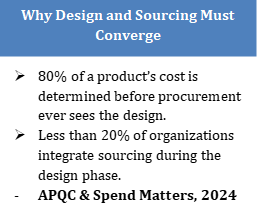
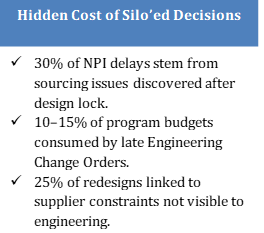
Industry data continues to show the cost of silo’ed processes. Up to thirty percent of NPI delays are tied to sourcing issues discovered after the BOM is locked, and as much as eighty percent of product cost is determined during design before procurement has visibility. Engineering Change Orders triggered by unavailable or high-risk parts can consume ten to fifteen percent of program budgets. Engineers are measured on innovation and speed, procurement on cost and risk, yet both depend on the same underlying data. When the BOM is disconnected, everyone loses, launches slip, costs rise, and supply risk grows.
The Human Factor: Why Procurement and Engineering Often Misalign
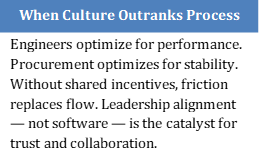
Technology can connect systems, but it cannot automatically align people. Organizational psychology research shows that engineers and procurement professionals often operate from opposing mindsets. Engineers value precision, autonomy, and innovation, viewing their work as a creative problem-solving craft. Procurement teams prioritize process, cost control, and risk mitigation, disciplines that can appear restrictive to design freedom. Harvard Business Review describes this as a ‘goal orientation gap,’ where engineers are optimization-driven while procurement is constraint-driven. MIT Sloan research adds that these functions rarely share feedback loops or success metrics, which deepens the divide. The result is subtle but pervasive friction: engineers perceive procurement as slowing progress, while procurement views engineering as dismissive of financial realities. Bridging this gap requires shared visibility and shared incentives. When both groups work from the same data and can see the downstream impact of their choices in real time, trust replaces tension. This is where the Design-to-Source model excels, reframing collaboration not as interference but as mutual empowerment.
Research Insight: Collaboration as a Design Discipline
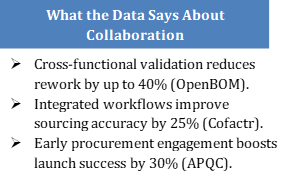
Studies across the industry support the value of early BOM collaboration. OpenBOM reports that cross-functional validation reduces design errors and rework by up to forty percent. Cofactr found that integrated procurement-engineering workflows improve sourcing speed and supplier accuracy. APQC adds that companies integrating sourcing data into early design stages see fewer design changes and higher product launch success rates. Together, these findings reinforce that design decisions are business decisions. When cost, risk, and availability data inform design choices, organizations innovate faster and smarter.
The Bridge: A Design-to-Source Approach (with AI at the Line-Item Level)
Caidentia enables a Design-to-Source model that unites engineering, procurement, and manufacturing around a single, living BOM. Its AI-driven intelligence operates at the line-item level, providing predictive cost modeling, alternative part recommendations, supplier risk scoring, and scenario simulations. Engineers gain real-time insight into cost and availability as they design. Procurement receives automated RFQs, quote analytics, and supplier intelligence. Manufacturing gains early visibility into supplier readiness and can validate part substitutions before production. Together, these capabilities reduce rework, accelerate sourcing, and improve launch outcomes. Every design or sourcing change is traceable within Caidentia’s unified BOM environment, giving organizations a single source of truth that supports auditability, compliance, and continuous improvement.
Unlike traditional PLM or sourcing tools that manage design data or procurement events in isolation, Caidentia serves as the connective layer between them. It doesn’t replace existing systems; it unifies them, providing a digital thread from engineering intent to sourcing execution. This architecture lets organizations preserve existing investments in CAD, ERP, and supplier systems while introducing a shared decision environment that drives measurable business impact.
A Unified BOM in Action
Consider a tier-1 automotive supplier developing an electronic control module. Traditionally, engineers finalize the design, only for procurement to discover that key components have long lead times. With Caidentia, AI circumvents such risks, recommending functionally equivalent components with better availability. Procurement can automatically initiate RFQs and secure supply, while manufacturing validates fit and readiness. The result is a design that stays on schedule, meets cost targets, and minimizes late-stage redesigns.
Automotive ROI Scenario
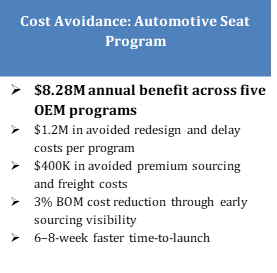
Now imagine a tier-1 supplier that designs and produces front seat frame assemblies for multiple vehicle platforms. Each seat frame contains approximately eighty-five subcomponents including stamped brackets, fasteners, sensors, weldments, recliner mechanisms, and trim connectors, sourced from around sixty suppliers across North America and Asia. Annual production volume is roughly five hundred thousand assemblies across five OEM programs.
Traditional Silo’ed Workflow (Before Caidentia)
Engineers design seat structures to meet crash, weight, and comfort specifications, often selecting materials or tolerances without visibility into cost or supply risk. Procurement typically engages post-design and discovers issues such as material price volatility or single-source parts, like specialty steel brackets or recliner gear sets. These sourcing constraints trigger tooling redesigns and validation delays of six to eight weeks per program. The average delay costs two hundred thousand dollars per week in labor, overhead, and lost margin, while emergency sourcing and expedited logistics add another four hundred thousand dollars per program. Altogether, the total cost impact is approximately 1.6 million dollars per program or eight million annually across five vehicle programs.
Design-to-Source Workflow (With Caidentia)
With Caidentia, engineering, procurement, and manufacturing teams share a unified BOM environment powered by line-level analytics. AI models evaluate material availability, supplier performance, and cost risk across every part, from weld nuts to recliner assemblies. The system identifies around ten percent of subcomponents as potential risks before tool design lock, automatically recommending qualified alternates. Procurement uses this visibility to negotiate early, secure volume contracts, and eliminate premium freight and late redesigns. Material and sourcing optimization yields an average three percent cost reduction on the seat frame BOM.
Benefits per program include material savings of fifty-six thousand dollars, avoided redesign and delay costs of 1.2 million dollars, and avoided premium sourcing costs of four hundred thousand dollars. This totals approximately $1.656 million dollars of savings per program or $8.28 million annually across five programs.
Financial Outcome and Scaled Impact
This example reflects only one high-volume seat assembly program. Extending design-to-source collaboration to other mechanical systems such as chassis, braking, HVAC, and closures compounds the benefits across the entire manufacturing spectrum. What begins as efficiency in one assembly evolves into an enterprise-wide transformation, multiplying returns and creating a culture of connected design and sourcing.
CPG ROI Scenario
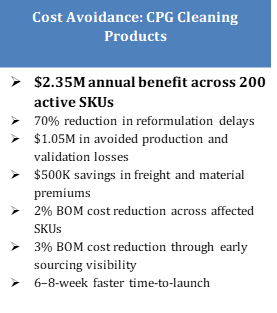
A global CPG manufacturer manages over two hundred active SKUs across multiple household cleaning and disinfectant brands. Each product formulation includes a small BOM of twenty to forty components: raw materials, chemical additives, fragrances, and packaging materials, sourced from a mix of domestic and international suppliers. The company faces variability in ingredient availability, lead times, and packaging supply, particularly for plastics, resins, and fragrance inputs. R&D teams frequently modify formulations or packaging designs to meet regulatory, branding, or cost targets, creating a continuous cycle of updates.
Traditional Silo’ed Workflow (Before Caidentia)
R&D formulates new SKUs based on marketing timelines, often with limited procurement input. Procurement becomes involved after R&D finalizes formulas or packaging, discovering that some ingredients are on allocation or suppliers are at capacity. Late-stage supplier changes trigger re-validation, reformulation, and labeling delays. A typical reformulation delay of three weeks per SKU can cost roughly $50,000 in lost production time and expedited sourcing; across 200 SKUs, a 15% impact rate (30 SKUs) results in approximately $1.5 million annually in operational inefficiencies, plus an additional $500,000 in freight and material premiums, totaling nearly $2 million per year (Siemens, PwC, NielsenIQ, GrowInCo).
Key Enablers of BOM Collaboration (and How AI Supports Them)
Organizations that successfully bridge engineering, procurement, and manufacturing share five key enablers, each supported by Caidentia’s AI-driven framework:
1.Integrated Data Infrastructure: PLM, ERP, and sourcing data flow bi-directionally to ensure a single source of truth.
2. Role-Based Views: Each function accesses the data most relevant to its decisions.
3. Cross-Functional Governance: Shared KPIs for BOM quality and change management.
4. Digital Collaboration: Unified environments with real-time updates and AI suggestions.
5. Leadership Sponsorship: Directors and VPs in Product Development and Supply Chain Engineering lead the transformation with measurable outcomes [7].
The Strategic Payoff
Organizations adopting AI-enabled design-to-source collaboration are realizing measurable improvements, including twenty-five to forty percent faster NPI cycles, five to fifteen percent lower direct material costs, and twenty percent fewer late engineering changes. These results align with research from Spend Matters and APQC on digital transformation and product development performance.
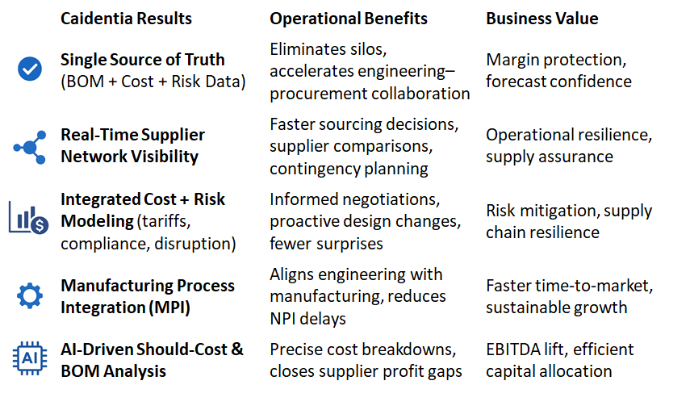
The impact of design-to-source collaboration becomes even clearer when viewed side-by-side across different manufacturing environments. Although automotive and CPG organizations operate with very different product structures, cost drivers, and sourcing challenges, both experience measurable gains when engineering and procurement align around a unified, intelligent BOM.
The table below summarizes how Caidentia translates line-level visibility into quantifiable business outcomes, reducing delays, lowering material costs, and strengthening supply resilience at scale. These examples illustrate a simple truth: regardless of product type or industry, early, data-driven collaboration consistently unlocks enterprise-level ROI.
The Time to Act Is Now
Ultimately, technology only succeeds when leaders champion collaboration. Design-to-source transformation begins not with a software rollout, but with executive alignment across engineering, sourcing, and operations. Senior leaders who set shared goals and incentives for these functions unlock the full value of collaboration, turning organizational friction into strategic momentum.
Bridging design and sourcing is not just a systems integration challenge; it is a leadership mandate. The real opportunity lies with senior executives who oversee product development, supply chain, and manufacturing functions and recognize that sustainable performance depends on collaboration across these traditional boundaries.
For leaders ready to close this gap and elevate how their teams work together, now is the time to act. The shift toward design-to-source collaboration is already reshaping how the most resilient organizations innovate, plan, and source.
Explore how unified BOM visibility and AI-driven collaboration can transform your organization’s innovation and sourcing performance by connecting with Samsung SDS and the Caidentia team. You can reach me directly at g.stasiw@samsung.com or 770-329-9716 to discuss how your leadership team can begin this journey.
From Functional Efficiency to Enterprise Resilience
Winning manufacturers will not simply design the best products or negotiate the best contracts, they will connect both worlds seamlessly. BOM collaboration powered by AI is no longer a technical option, it is a strategic necessity. For organizations ready to embrace it, the rewards are measurable, repeatable, and transformational.
As manufacturers move toward digital twins, autonomous sourcing, and circular-economy design, the ability to connect cost, risk, and sustainability data at the design stage will define industry leaders. Design-to-source collaboration is not just the next step. It’s the foundation for an intelligent enterprise and your newest competitive advantage.
George Stasiw is a recognized thought leader in manufacturing, supply chain, procurement, and technology innovation. With a foundation built at IBM and advanced AI studies at MIT, he is now a prominent voice for design-to-source solutions at Samsung SDS. George thrives when brainstorming with organizations looking to enhance procurement processes, optimize BOM management, and connect their design and sourcing teams. Start a conversation with him at g.stasiw@samsung.com.