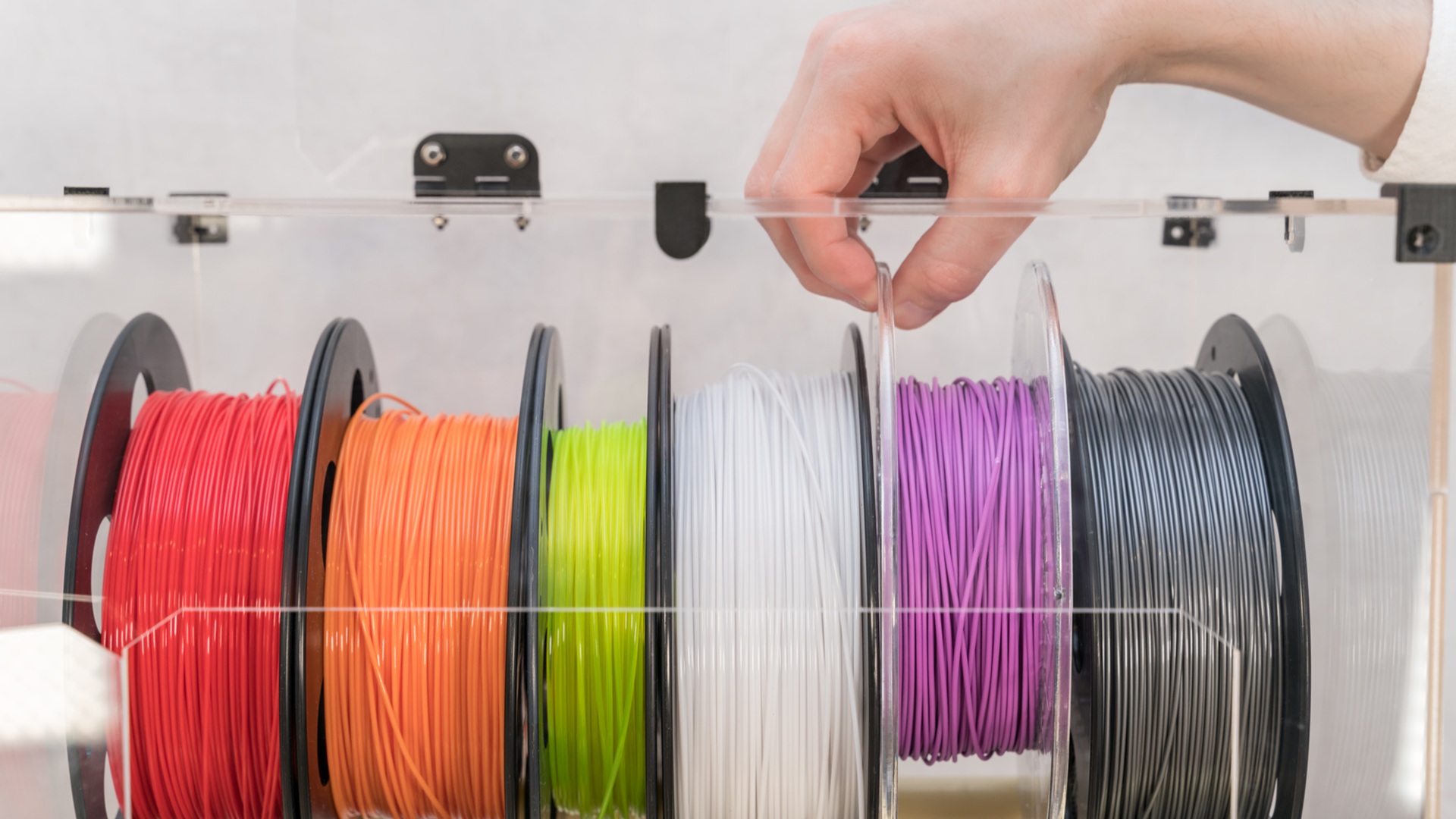
Most engineers start with PLA because it’s cost-effective, forgiving, and prints like a dream on a $200 Ender. That’s fine, until your prototype warps inside a car on a summer day, or your jig cracks under load, or your outdoor housing turns brittle after six months of UV exposure.
At that point, you’re not dealing with a printing problem. You’re dealing with a materials problem.
Here’s your systematic approach to solving it.
General-Purpose Filaments: The Design Verification Phase
PLA and PETG aren’t hobbyist toys. They’re legitimate engineering tools for the fit-check stage of product development. If you’re validating geometry, testing assembly clearances, or printing non-load-bearing organizational parts, these materials make sense because they’re fast, cheap, and dimensionally accurate.
They can save your money and your sanity.
Understanding Material Behavior Under Stress
But here’s where the physics betrays you: standard plastics have a glass transition temperature around 60°C (140°F), meaning they soften under heat. They creep under constant load, deforming slowly over time, even at room temperature.
UV radiation breaks down polymer chains, turning that outdoor enclosure into a brittle shell within months. Oils and solvents can cause swelling and deformation that propagates until catastrophic failure.
If your part experiences heat above 60°C (140°F), continuous mechanical load, UV exposure, or chemical contact, PLA vs. PETG vs. ABS becomes irrelevant.
You need engineering-grade filament.
Infrastructure Requirements for Engineering Materials
Let’s be direct: functional 3D printing with high-performance materials requires specific hardware upgrades.
You cannot print abrasive carbon fiber-reinforced filament through a brass nozzle without destroying it within hours. You cannot print hygroscopic nylon without a dryer. You cannot print large polycarbonate parts without an enclosure.
The essential upgrade trinity: a hardened nozzle (hardened steel, ruby, or DiamondBack) for abrasion resistance, a filament dryer for moisture control, and a heated enclosure for thermal stability.
For high-temperature 3D printing above 240°C (464°F), you also need an all-metal hot end. If you’re printing styrene-based materials or ultra-high-temp polymers in an office, add air filtration to meet manufacturing safety regulations.
Read this article in full here.
We manufacture all of our printers and filaments in our 68,000 ft² manufacturing facility (located in Grand Rapids, Michigan) using state-of-the-art equipment and processes. Our goal continues to be to make the most innovative filaments on the market – targeting difficult end-use applications where functionality is king.