

In today’s automotive industry, cost pressure is a constant challenge cemented deep within the industry. Annual OEM price‑down expectations, volatile raw‑material markets, electrification investments, capacity constraints, and customer cost penalties for quality and delivery issues have compressed margins across the industry. Given this environment, many suppliers turn inward to identify cost savings, tasking finance, procurement, and operations teams with internal cost reduction targets. While necessary, internally-led cost reviews consistently leave significant value on the table. Independent, third‑party cost savings assessments have proven to deliver superior return on investment (ROI), greater sustainability, and faster execution—particularly in complex, asset‑intensive automotive manufacturing environments.
Unique Cost Challenges Facing Automotive Suppliers
Automotive Tier 1 manufacturers operate with a cost structure unlike most other industries. Capital investment can be high, product lifecycles are becoming more variable, engineering changes are frequent, and volumes are tightly coupled to OEM production schedules. Layered on top are customer‑mandated cost reductions, often ranging from 2–5% annually, regardless of commodity inflation or labor pressures. McKinsey(1) research shows that traditional, incremental cost‑cutting approaches have largely been exhausted in in many sectors, yielding diminishing returns while increasing operational risk.
Internally driven assessments tend to focus on controllable, short‑term levers: headcount controls, overtime reduction, supplier price renegotiation, or discretionary spend freezes. These actions may temporarily protect margins, but they rarely address structural inefficiencies embedded in plant footprints, process design, sourcing strategies, or make‑versus‑buy decisions—areas where the largest savings opportunities reside for Tier 1 manufacturers.
Why Internal Cost Assessments Underperform in Automotive Manufacturing
Internal teams are constrained by organizational history, functional silos, and OEM relationship sensitivities. Cost structures tied to legacy platforms, customer‑specific production lines, or long‑standing supplier agreements are often treated as immutable. The U.S. Government Accountability Office (GAO) (2) identifies confirmation bias and limited comparative data as persistent weaknesses in internally generated cost assessments, particularly in complex manufacturing environments where historical assumptions go unchallenged.
In automotive Tier 1 organizations, this bias is amplified. Engineering, operations, procurement, and finance frequently optimize within their own silos, unintentionally shifting cost rather than eliminating it. For example, internal procurement teams may secure piece‑price reductions that increase logistics costs or quality risk, while operations teams implement labor efficiencies that erode throughput or OEE. Without an independent, enterprise‑level lens, these tradeoffs remain invisible.
The Power of Independent Benchmarking in Automotive Cost Structures
Third‑party cost savings assessments can bring something internal teams cannot: deep, external benchmarking grounded in automotive‑specific data. Reputable firms with real time experience in the industry can enable precise comparisons across labor productivity, overhead absorption, procurement efficiency, and asset utilization.
Internal teams, limited to their own historical baselines and OEM‑specific constraints, rarely recognize how far their cost structures deviate from industry best‑in‑class performance.
ROI: External Assessments Deliver Multiples, Not Marginal Gains
The financial case for independent cost savings assessments is particularly compelling in automotive manufacturing. Research(3) shows that leading organizations routinely achieve ROI of up to 9x on investments in cost optimization and benchmarking initiatives. These returns are driven not by headcount reduction alone, but by structural improvements in sourcing strategy, plant footprint rationalization, automation targeting, and indirect cost redesign.
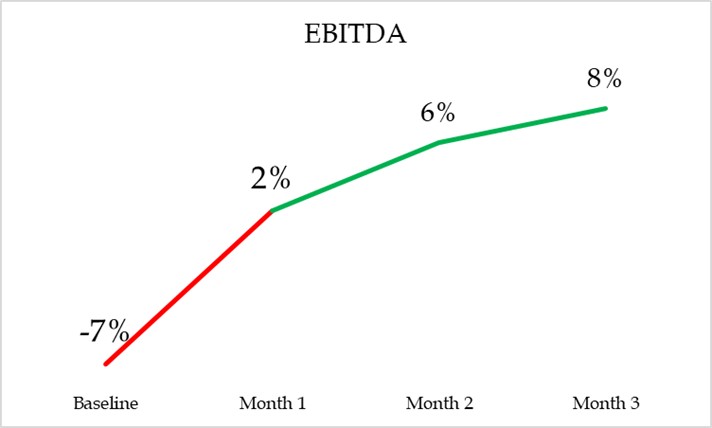
Example 1: Strategic Manufacturing Solutions external cost assessment delivered a 15% EBITDA performance improvement within 90 days.
McKinsey’s analysis(4) of more than 340,000 transformation initiatives across industrial sectors reinforces this conclusion. Automotive and advanced‑industry manufacturers that engaged in externally informed cost transformations typically targeted 15–30% savings over 18–24 months, compared to internal savings rates of 3–5% annually. Importantly, organizations that successfully met procurement and operations savings targets were nearly twice as likely to achieve enterprise‑wide financial objectives.
In contrast, internally led cost programs often stall after initial quick wins, as organizational resistance and execution fatigue set in. Independent assessments introduce both urgency and credibility, enabling leadership teams to make decisions that internal politics might otherwise delay or dilute.
Objectivity Enables Decisions Tier 1s Often Avoid
Perhaps the greatest value of an external assessment in an automotive Tier 1 environment is objectivity. Decisions around plant consolidation, vertical integration, supplier rationalization, or customer‑specific cost recovery are inherently sensitive—particularly when OEM relationships are at stake. Strategic Manufacturing Solutions experience shows that organizations lacking independent perspectives tend to preserve internal political status quo, inefficient structures to avoid internal disruption, or customer set paradigms, even when data clearly supports change.
An independent third party operates outside internal reporting lines and incentive structures. This independence allows recommendations to be grounded in economic reality rather than organizational comfort. In practice, this often enables Tier 1 suppliers to address long‑standing inefficiencies such as underutilized assets, misaligned engineering support costs, redundant indirect functions, or supplier dependency risks—areas internal teams may acknowledge privately but struggle to resolve.
Speed and Execution in a Volatile Automotive Environment
Speed matters in automotive. Volume swings, program launches, and customer disruptions leave little margin for prolonged analysis. External assessment teams deploy proprietary models and benchmarking data across prior engagements.
By contrast, internal teams often spend months reconciling data definitions, debating allocation methodologies, and validating assumptions, delaying action and eroding credibility with OEM customers, leadership teams, and investors alike.

Example 2: Strategic Manufacturing Solutions external cost assessment delivered identified cost savings opportunities 10x higher than client expectations.
Beyond Cost Cutting: Building Sustainable Advantage
The most effective independent cost savings assessments do more than identify reductions; they build capabilities. Implementation plans should include new tools, processes, and standards that both implement the savings and deliver a sustainable method to prevent costs from returning to pre-assessment levels. Automotive Tier 1 suppliers that leverage external benchmarking are better positioned to reinvest savings into automation, digital manufacturing, advanced analytics, and supplier development—critical enablers for long‑term competitiveness in an electrified and software‑driven automotive future.
Conclusion
For automotive Tier 1 manufacturers, cost savings are no longer about finding incremental efficiencies—they are about reshaping the cost base to survive and compete in an increasingly unforgiving industry. Independent, third‑party cost savings assessments consistently outperform internal reviews because they bring objectivity, deep benchmarking, execution discipline, and credibility that internal teams cannot replicate alone.
The data is clear: externally informed cost programs deliver higher ROI, faster results, and more sustainable outcomes. In an industry where margins are thin and mistakes are expensive, engaging an independent assessor is not a luxury, it is a strategic necessity.
Strategic Manufacturing Solutions is a manufacturing consulting firm based in Livonia, Michigan, dedicated to helping manufacturers improve performance, reduce costs, and drive operational excellence. With deep expertise in manufacturing strategy, process optimization, and organizational effectiveness, the firm partners with clients to deliver practical, data-driven solutions that create measurable results. Strategic Manufacturing Solutions works closely with leadership teams and shop-floor operations to align strategy with execution and build sustainable competitive advantage.
References
- (1) “A smarter approach to cost reduction in the public sector.” McKinsey &Company, 18-Jun-2018, https://www.mckinsey.com/industries/public-sector/our-insights/a-smarter-approach-to-cost-reduction-in-the-public-sector.
- (2) US Government Accountability Office. Cost Estimating and Assessment Guide. Publisher (if different), March 2020, https://www.gao.gov/assets/gao-20-195g.pdf.
- (3) “Sourcing and Procurement Benchmarking: Assess Investments and Operational Excellence Fast and Objectively.” The Hackett Group, , https://www.thehackettgroup.com/sourcing-procurement-strategy/sourcing-procurement-benchmarking
- (4) “Aim higher and move faster for successful procurement-led transformation.” McKinsey &Company, 9-Jun-2025, https://www.mckinsey.com/capabilities/transformation/ our-insights/aim-higher-and-move-faster-for-successful-procurement-led-transformation
Strategic Manufacturing Solutions is a manufacturing consulting firm based in Livonia, Michigan, dedicated to helping manufacturers improve performance, reduce costs, and drive operational excellence. With deep expertise in manufacturing strategy, process optimization, and organizational effectiveness, the firm partners with clients to deliver practical, data-driven solutions that create measurable results. Strategic Manufacturing Solutions works closely with leadership teams and shop-floor operations to align strategy with execution and build sustainable competitive advantage.