
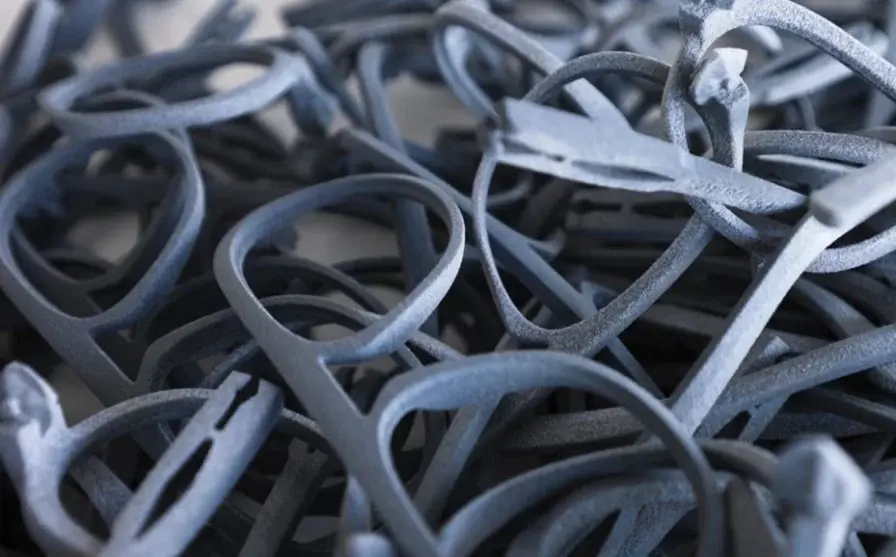
If you think the topic of 3D printing seems confusing or overwhelming, you’re not alone. There’s a lot to consider. But the more you learn the clearer the picture will become. A good place to start is becoming familiar with the different additive manufacturing (AM) technologies – the 3D printing methods – that exist in the marketplace. To help you toward that goal, this post takes a closer look at one of those technologies – powder bed fusion – so you can better understand how it’s used, where it fits, and when to consider it.
What is Powder Bed Fusion?
Powder Bed Fusion (PBF) is an additive manufacturing category that uses thermal energy to selectively fuse granular materials into solid 3D shapes. A laser or electron beam melts specific areas of a powder bed layer-by-layer, while the unfused powder acts as a self-supporting medium for complex geometries.
The powder bed fusion process is divided into several broad categories differentiated by the method of heat used:
- Laser Powder Bed Fusion: Employs a high-powered laser to fuse the 3D printer powder, suitable for both polymers and metals.
- Electron Beam Melting: Uses an electron beam in a vacuum chamber, typically reserved for high-end metal applications where strength and thermal resistance are critical.
- Agent-Based Thermal Fusion: A fluid agent is jetted onto the powder bed and infrared lamps then apply heat. The powder selectively fuses where the agent has been deposited, forming the part.
Each approach shares the core principle of building parts from a bed of powder, but the fusion mechanism and suitable materials vary, affecting their ideal use cases. Although metal accounts for a large percentage of PBF market share, this blog post will focus specifically on polymer PBF 3D printing.
Read this article in full here.