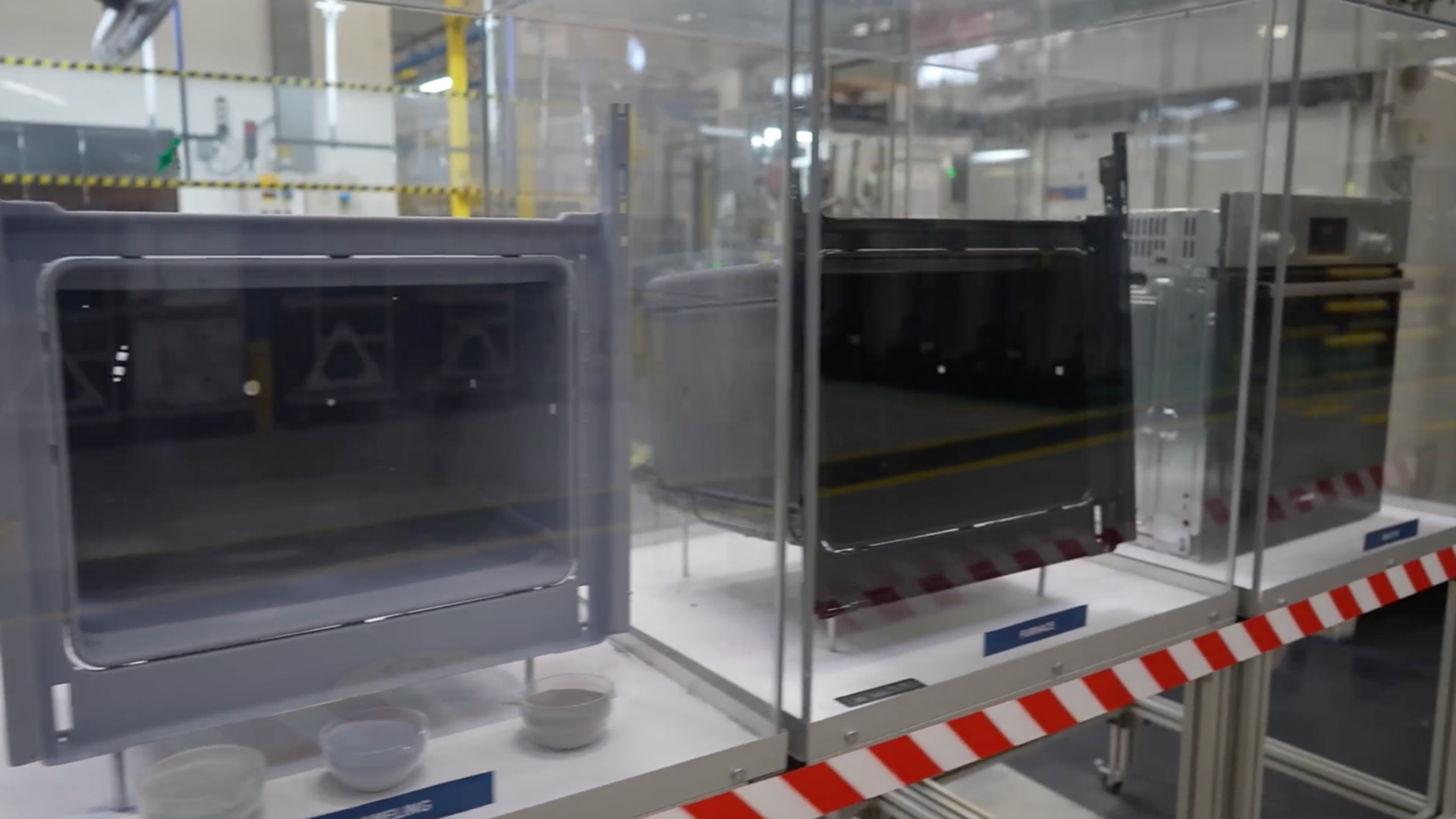
Oven cavity production involves several demanding steps, including welding, degreasing, enameling, and high-temperature furnace firing. These stages can damage or erase conventional 2D codes such as Data Matrix and QR codes, especially when parts are exposed to heat, coatings, and severe surface changes. Once the code is lost, it becomes difficult to track an individual cavity through production, connect process data to the correct part, or determine where a defect originated.
For B/S/H, this created a real operational problem. Without a reliable way to identify each cavity across the full production flow, product visibility was interrupted, scrap and rework increased, and quality control became harder to manage. It also limited the company’s ability to move forward with data-driven manufacturing and digital transformation.
B/S/H needed a code that could be applied directly to each cavity, remain readable through harsh processes, and support full process visibility from the first stages of production to the finished product.
Part 1
B/S/H addressed this challenge by implementing Cosmodot’s CDOT Code in oven cavity production. CDOT Code is a durable direct part marking solution designed to remain readable even after demanding industrial processes that typically cause conventional codes to fail.
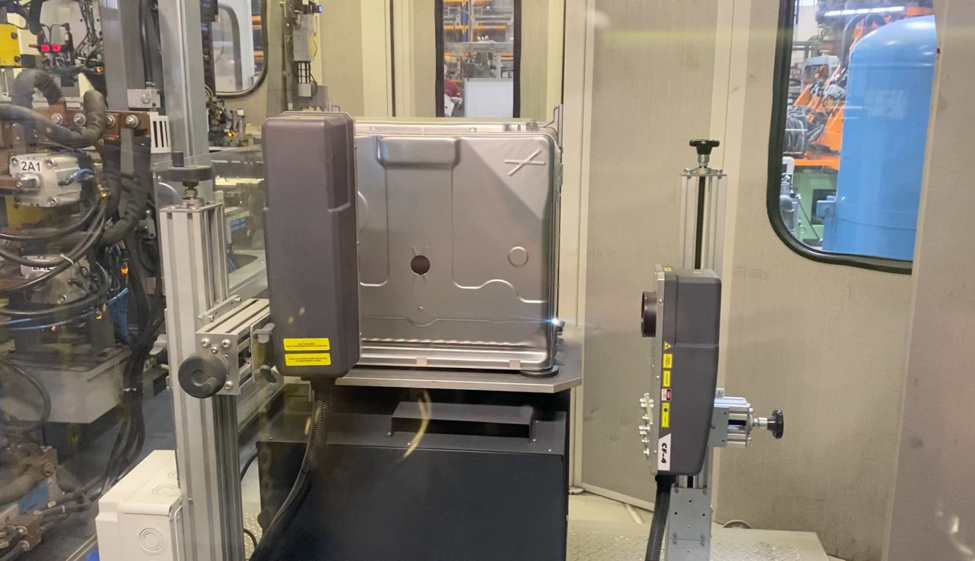
Readable CDOT Code after 120 μm enamel powder coating and furnace firing at 1562°F (850°C). CDOT Code being laser-marked directly onto a welded oven cavity.
Each oven cavity was marked with a unique CDOT Code using standard laser marking equipment. This gave every part its own permanent identity, allowing it to be tracked across the full production flow. Unlike traditional 2D codes, which often become unreadable after enameling or high-temperature treatment, the CDOT Code remained detectable and usable even after the surface condition changed significantly.
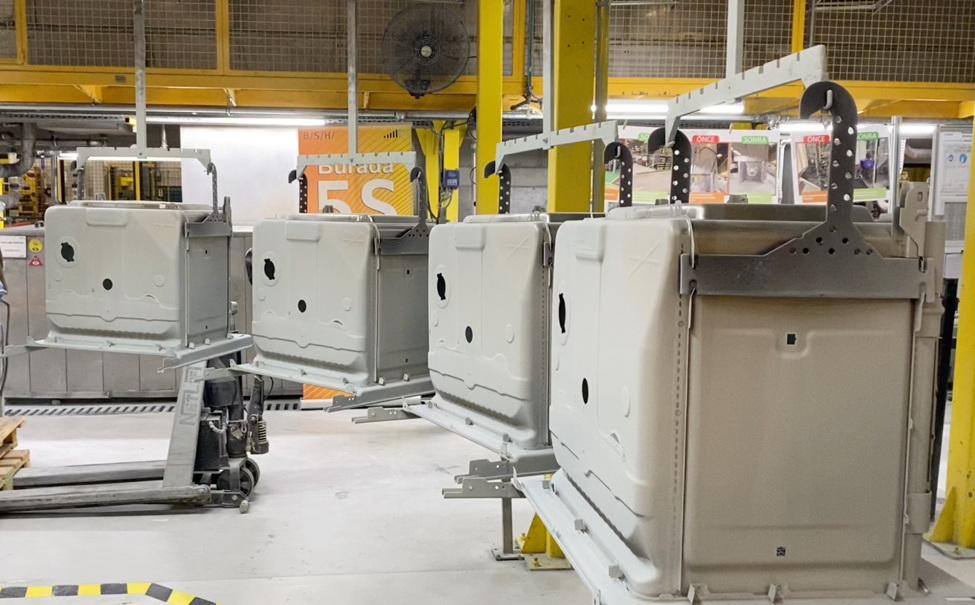
Enamel-coated oven cavities with the CDOT Code remaining readable after powder coating.
This mattered because oven cavity production is not a simple or clean environment for part identification. Parts move through multiple intensive steps, and traceability can easily break if the code disappears midway. With CDOT Code, B/S/H was able to maintain part identity through these stages and keep the link between the physical product and its production record intact.
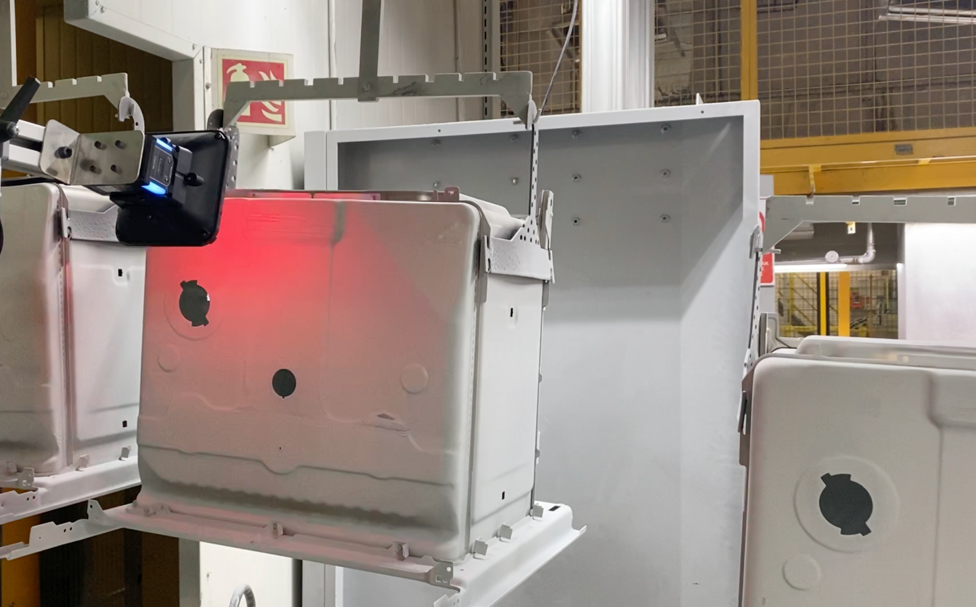
Verification reading of a CDOT Code on an enamel-coated oven cavity after powder coating.
Part 2
Once each cavity could be identified reliably throughout production, B/S/H was able to connect process data directly to the correct part in real time. Parameters such as welding data, temperature history, pressure, and treatment conditions could now be recorded and associated with each individual cavity. This improved visibility across the line and made it far easier to understand how each product moved through production.
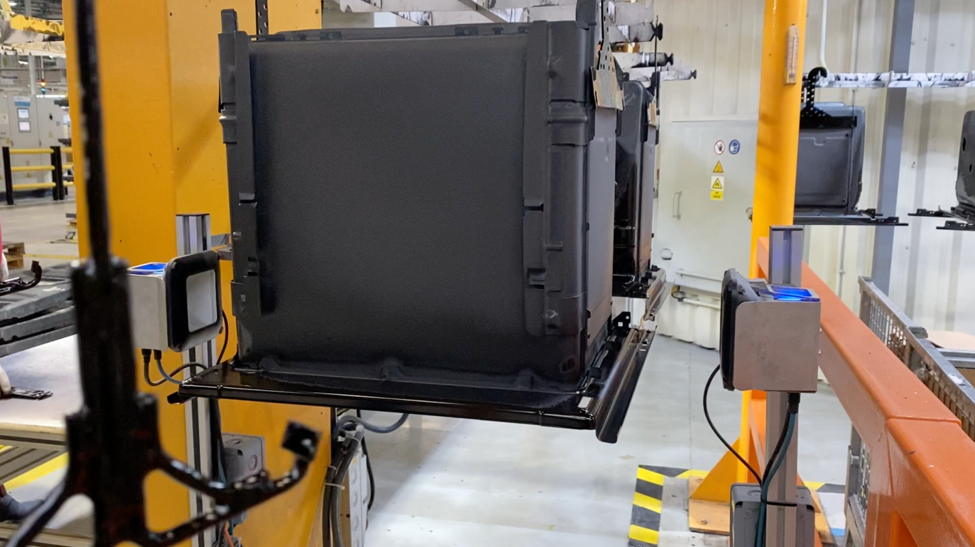
Verification reading of a CDOT Code on an oven cavity after furnace firing.
The impact was practical and measurable. Product losses fell because cavities no longer disappeared from the traceability system when conventional codes failed. Scrap and rework were reduced because problematic parts could be identified and isolated faster. Quality control also grew stronger because process parameters could be reviewed at the individual part level, making it easier to trace defects back to their source and respond quickly to complaints or deviations.
As the Plant Director at B/S/H explained, oven cavity production is delicate enough that each body must carry its own unique identity throughout the process. Conventional codes may fail under such intense conditions, while CDOT Code remains readable even when partially damaged. That reliability makes it possible to trace how each body moved through production and under which conditions it was manufactured, helping the team quickly identify the source of any potential issue.
Just as important, CDOT fit into B/S/H’s existing production environment without any special-purpose equipment. The code is applied with standard laser marking devices and read with common industrial barcode readers already available on the market, which made adoption straightforward and improved traceability without adding complexity to daily operations.
Conclusion
By using a CDOT Code that remains readable through welding, enameling, and high-temperature furnace firing, B/S/H achieved end-to-end traceability in oven cavity production. Each cavity kept its identity throughout the full manufacturing process, allowing process conditions to stay linked to the correct part from start to finish.
This gave B/S/H better control over scrap, rework, and quality, while also creating the data visibility needed for broader digital manufacturing goals. More importantly, it showed that reliable traceability is possible even in production environments where conventional codes fail. For B/S/H, CDOT Code was not just a marking improvement. It became a practical enabler of stronger process control, clearer root-cause analysis, and a more connected production system.
About Cosmodot
Cosmodot developed CDOT Code, a new unique identifier symbology built specifically for direct part marking. It stands out for being survivable, high in data capacity, and reusable, allowing the same permanent ID to be read reliably even as parts go through harsh production steps and challenging surface changes.
Cosmodot addresses a critical market need for durable part-level identification in environments where conventional codes fail. By helping manufacturers maintain part identity in harsh production settings, Cosmodot improves process continuity, strengthens traceability, and supports high-impact productivity gains across industries including home appliances, automotive, aerospace, defense, iron and steel, casting, forging, electronics, and semiconductors.
Learn more about the CDOT Code here.
For additional information on CDOT demos, project implementations, and pricing, contact info@thecosmodot.com

Mete Kayalar is the Co-Founder and Chief Technology Officer of Cosmodot and the principal inventor of the CDOT AI Code, an AI-powered industrial identity system that makes physical parts readable through the world’s harshest manufacturing environments. With more than 25 years of experience in enterprise software, IoT infrastructure, ERP systems, and AI-driven industrial platforms, including prior leadership experience at Oracle, he has built his career around one central challenge: turning physical operations into reliable, structured, and actionable digital intelligence. His earlier patented work in handwriting digitalization and smart pen technologies reflects the same innovation path, converting physical information into usable digital data. At Cosmodot, his technical vision enables manufacturers to preserve a part’s identity from its earliest production stage through heat, abrasion, coating, casting, forging, and other extreme processes. His work gives industrial parts a persistent digital identity, supporting part-level traceability, production intelligence, digital twin readiness, and industrial AI at scale.