

The manufacturers who need artificial intelligence the most are usually the least confident about where to start. A simple pyramid — and a genuinely un-ambitious first ninety days — is what closes that gap. The vast majority of smaller companies are not competing against other smaller companies. They are competing against companies with bottomless budgets, dedicated data scientists, and production facilities built from the ground up with sensors built in. Thus, a genuine opening for any AI conversation with such firms would be an honest admission of this difference in capabilities and the one and only meaningful question: How do you leverage AI with a limited budget?
Once the topic turns to “AI”, the knee-jerk reaction is to go for the cutting edge of the technology tree, to reach for predictive models, self-optimizing production lines and autonomous scheduling, all packaged neatly into a software solution with a plan of execution and contract to go along with it. Almost invariably, this is the wrong approach to take and the mistake follows a rather predictable and structural pattern known and understood by industrial engineering for decades, well before anyone coined the term “AI”. The tools which are more likely than others to produce tangible results are general purpose AI assistants that are readily available to anyone with Internet connection.
Why Most AI Efforts Fail Before They Start
If you asked a small manufacturer what keeps them awake at night, it’s very unlikely to hear about AI. According to the National Association of Manufacturers’ fourth-quarter 2025 outlook survey among manufacturers, trade uncertainties ranked first in terms of business concerns with a percentage of 73.1%, followed closely by increasing health care and insurance expenses with a share of 70.2%. Weaker domestic economic performance and U.S. sales growth came in third with 60.1%. AI is not mentioned even within the top three business issues that worry manufacturers – and it does matter, as it shows that AI case should be made differently than on fear of being left behind.
It is not that small manufacturers found a way to implement AI successfully behind the scenes. As of August 2025, only 8.8% of U.S. small businesses (companies employing less than 250 people) were using AI technologies to produce goods or services compared to 6.3% in February 2025, whereas in large companies, the proportion was 11.1%. Moreover, half of the small businesses which used any kind of AI technology did not invest anything in implementing AI properly. The difference is in order, confidence, and experience.
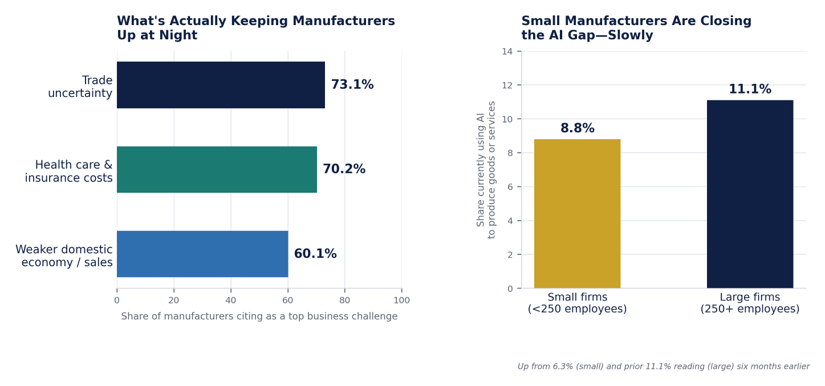
FIGURE 1 — Business fundamentals, not AI, dominate what manufacturers report worrying about — and small manufacturers still lag well behind large ones in actually putting AI to use. Sources: National Association of Manufacturers, 2025 Fourth Quarter Manufacturers’ Outlook Survey (Dec. 2025); U.S. Small Business Administration, Office of Advocacy, “AI in Business: Small Firms Closing In” (Sept. 2025).
This is not a tale of a shortage of ambition. This is a tale of sequencing. Every single one of these companies continues, somewhere in the depths of its operations, to use Excel spreadsheets, white boards, paper travelers, and tribal knowledge held by one or two individuals while they continue to be asked to compete in the digitally driven marketplace.
“The future will not be won by the factories with the most AI. It will be won by the factories that solve the most problems.”
The Smart Manufacturing Pyramid
All companies aim to begin at the pinnacle of the stack. It is for this very reason that they fail. AI and analytics occupy a position close to the top of the five-level pyramid structure, not the bottom, and each layer must be strong before it, which means the layer below it should have been successful.
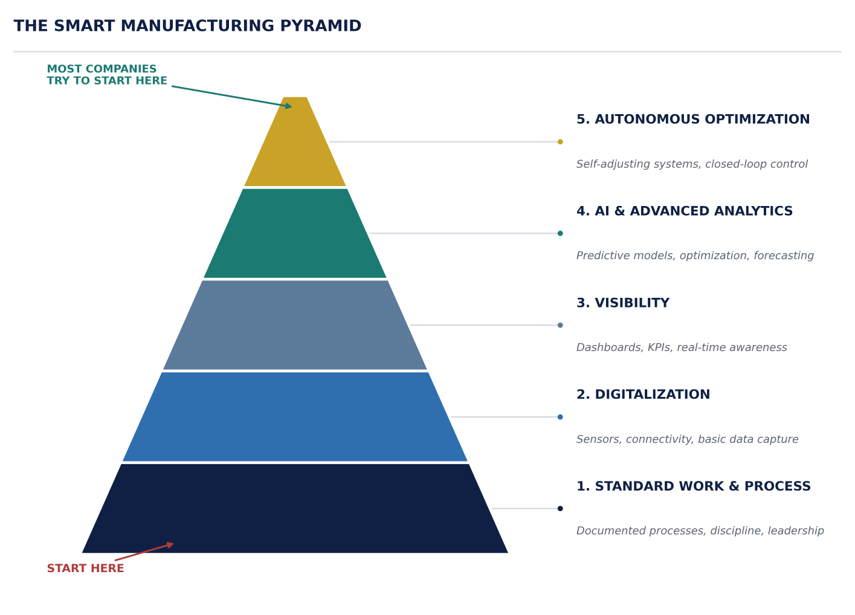
FIGURE 2 — The Smart Manufacturing Pyramid. Each level depends on the one below it. Most failed AI initiatives are attempts to skip two or three levels at once.
TABLE 1 — THE FIVE LEVELS, BOTTOM TO TOP
| Level | What It Actually Is | Why Skipping It Fails |
| 1. Standard Work & Process | Documented processes, discipline, leadership — the database, in effect, that everything above it reads from. | Without it, there’s no consistent process to digitize or automate — only variation. |
| 2. Digitalization | Sensors, connectivity, basic data capture — barcodes and a shared spreadsheet count, at first. | Without it, there’s no data for a dashboard to show or a model to learn from. |
| 3. Visibility | Dashboards, KPIs, real-time awareness — even a whiteboard updated hourly is a form of this. | Without it, nobody notices the problem an AI model would otherwise be built to solve. |
| 4. AI & Advanced Analytics | Predictive models, optimization, forecasting, natural-language tools for everyday tasks. | This is where most companies try to start — and where most initiatives quietly die for lack of the three levels beneath it. |
| 5. Autonomous Optimization | Self-adjusting systems, closed-loop control, minimal human intervention in routine decisions. | The ambitious end state, reachable only once the first four levels are already trustworthy — not before. |
“You cannot automate chaos. Before AI comes visibility. Before visibility comes discipline. Before discipline comes leadership.”
A predictive maintenance algorithm tacked onto a process that lacks documentation and consistency does not make the process any better; all it does is give you confident predictions about noise. It is not a maturity framework for the sake of being a maturity framework; it is a sequencing requirement, and failing it is by far the most frequent root cause of stalled AI pilots. Skip a level, and you won’t go any faster to the top; you will just find out, more painfully and expensively, later on.
The Ninety Day Starting Point – And Beyond
Do not begin your journey with an expensive roadmap; begin instead on Monday morning. This impulse to create a total transformation plan for digitalization prior to taking action is another way of beginning at the pyramid top, this time dressed up as a strategic consultant rather than a software provider. It’s possible to implement a five-step plan without placing any huge bets on it.
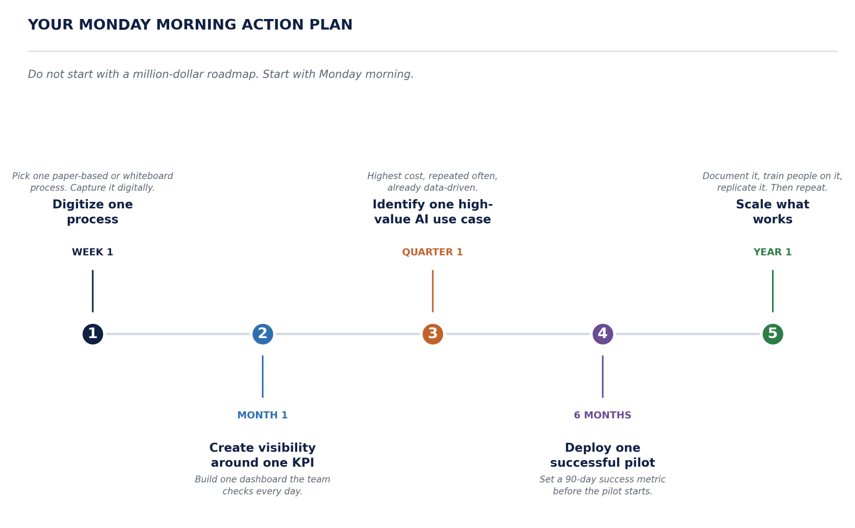
FIGURE 3 — The Monday Morning Action Plan, staged from Week 1 through Year 1. Each stage builds on proof from the one before it, not a calendar date.
TABLE 2 — THE MONDAY MORNING ACTION PLAN
| Stage | Objective | What It Actually Looks Like |
| Week 1 | Digitize one process | Pick one paper-based or whiteboard process — a travel router, a shift handoff log, a quality checklist. Capture it digitally. Nothing more ambitious than that. |
| Month 1 | Create visibility around one KPI | Build one dashboard the team actually checks every day: downtime, scrap rate, on-time delivery, or first-pass yield. |
| Quarter 1 (~90 days) | Identify one high-value AI use case | Apply the pain-point filter: highest cost, repeated often, and already data-driven — not the most impressive use case on paper, the most defensible one in a budget meeting. |
| 6 Months | Deploy one successful pilot | Set a 90-day success metric in writing before the pilot starts. Prove it before scaling to a second use case. |
| Year 1 | Scale what works | Document it, train people on it, replicate it in the next line or shift. Then — and only then — go find the next pain point. |
The ninety-day timeframe is by design the point at which the strategy calls for one validated pilot effort, not a collection of AI initiatives vying for validation. It echoes an old industrial engineering principle when setting up gates for any pilot: demonstrate preparedness through data before scaling up, since meeting a deadline does not equate to meeting the goal of being validated. Many programs go about this in reverse, announcing the date of scaling up first and then hoping that the data will fall in line during the pilot phase.
The Simplest Starting Point Doesn’t Require a Data Team
Rather than creating something custom right from the start, the low hanging fruit is the set of off-the-shelf AI assistants that are already out there and that can be obtained either for free or as part of a paid subscription, with no customization involved. There are basically different types of such tools, and it pays to use the right type for the job.
TABLE 3 — CATEGORIES OF STARTING TOOLS
| Category | Best For | Representative Shop-Floor Use |
| Long documents, careful step-by-step reasoning, technical review | Analyze a 50-page customer spec and list every requirement; review supplier contracts for risk clauses and penalty terms. | |
| Everyday versatility, brainstorming, quick answers | Draft SOPs and work instructions in plain shop-floor language; write RFQ emails to suppliers in another language. | |
| Living inside the productivity tools already in use | Summarize production data inside a spreadsheet; turn a meeting recording into a clean list of action items. | |
| Interpreting photos, defects, or visual inspection data | Photograph a defect on the line and ask what might be causing it; compare a finished part against a reference photo. |
None of this needs a new data scientist, a rack of servers, or a six-figure licensing deal. It needs choosing a single recurring and annoying problem to see if an affordable subscription service — or even the free service, for that matter — can make any inroads on it. This is precisely what the 90-day plan asks of a business, starting small and inexpensive first.
The organizations that will come out ahead when it comes to applying AI within manufacturing in the coming years are likely not going to have the largest budgets, nor are they likely to be deploying the most expensive vendor platform out there. Instead, these will be the organizations that pay heed to the order – standardization prior to digitalization, digitalization prior to visibility, visibility prior to AI, and AI prior to autonomy – and use the general-purpose tools at hand on their laptops before investing in a specialized system that needs to be implemented. The ninety-day plan that culminates in just one pilot validated on actual plant-floor data does more for the small manufacturer than any transformation roadmap that doesn’t even get off the ground.
Disclosure: The views expressed in this article are those of the authors and do not represent the views or positions of any organization with which they are affiliated.
Vijay Gurav is an industrial engineer with over a decade of experience in manufacturing system design and process optimization. He specializes in assembly line design, time studies, and Industry 4.0 integration. His current work applies AI, computer vision, and optimization algorithms to enhance efficiency, quality, and cost performance in large-scale manufacturing.