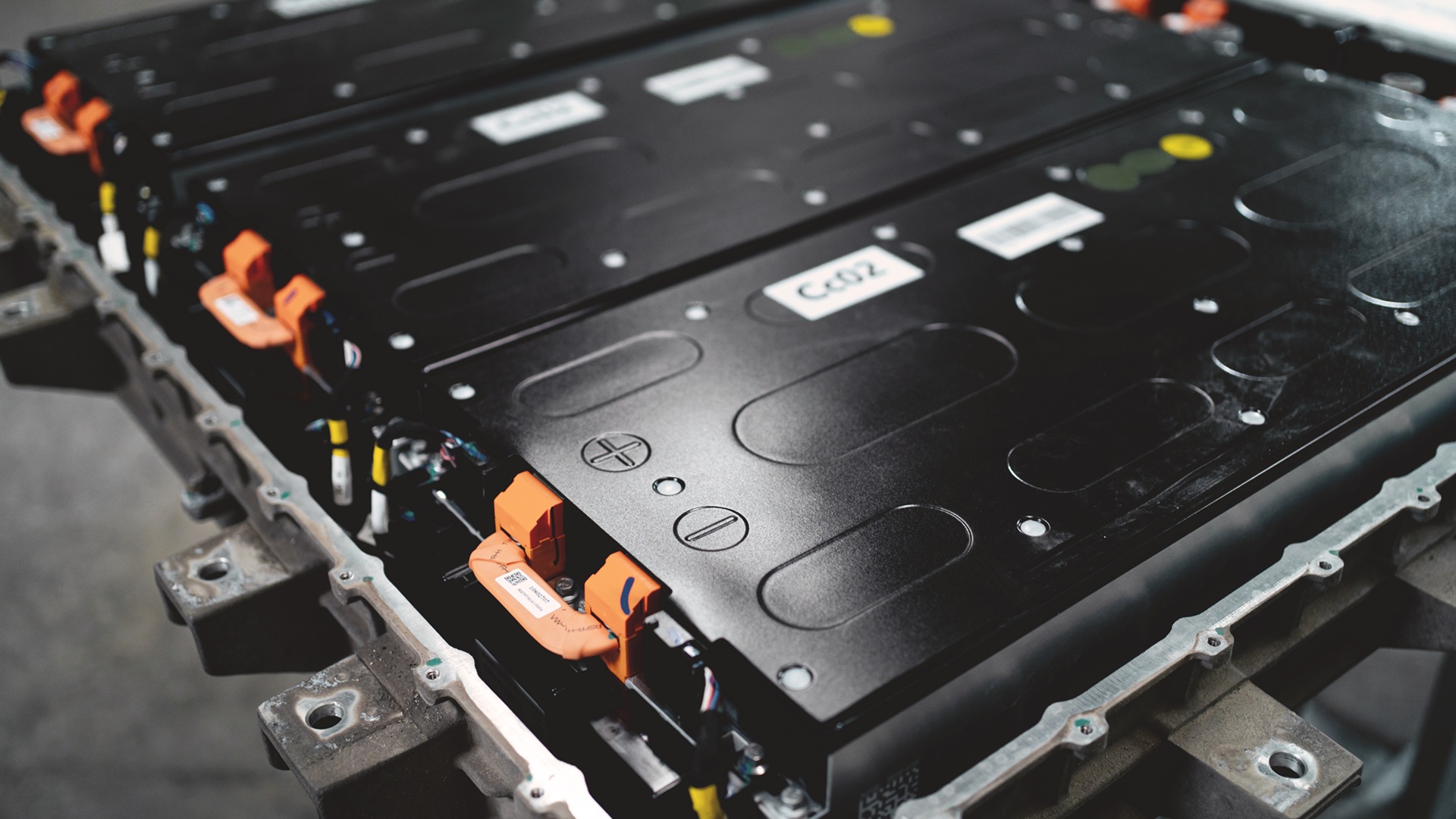
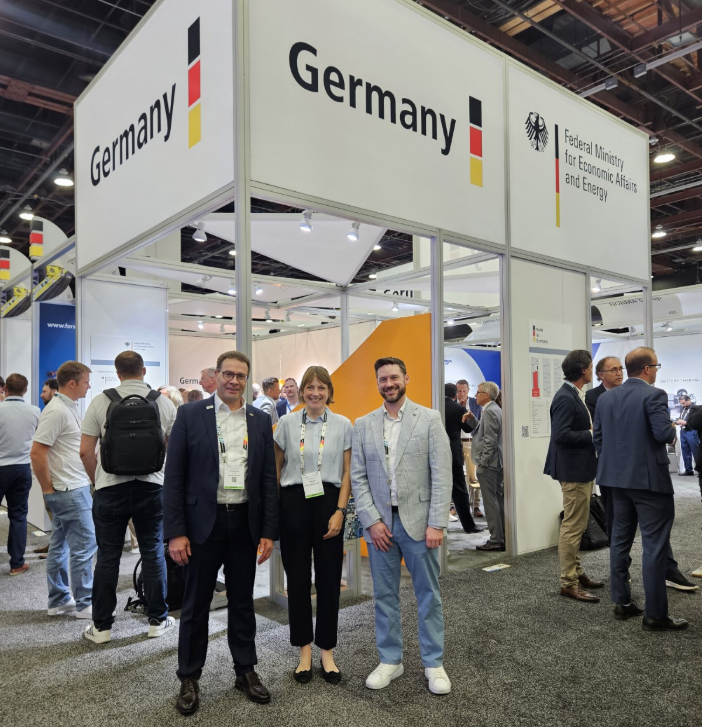
At The Battery Show in Detroit Oct. 12-15, the challenge was as much about building batteries as improving them. More than 1,000 exhibitors showcased technology spanning the battery supply chain, including stationary energy storage, electric vehicles, automated battery assembly and charging infrastructure.
“Right now you probably have six devices that you’re carrying on you that have a battery in them, and you probably don’t ever think about what materials go into those, how they’re manufactured, how they’re tested,” said Russ Zarras, director of strategic initiatives at Fraunhofer USA.
“You probably think about how long they last, how long they retain a charge, but beyond that you don’t really think about it. But every day you interact with batteries. This is a huge topic that has kind of become ubiquitous across all different types of manufacturing, material science, and the supply chain.”
However, those pursuing the battery market need specialized production processes that can control defects, adapt to different cell designs and keep costs in check.
Fraunhofer researchers addressed these needs with their latest research in battery technology at The Battery Show, discussing how dry electrode production could reduce the space and energy required to manufacture cells, why electrolyte filling deserves more attention and how AI-assisted weld inspection could help manufacturers identify defects during battery module assembly.
“We’ve seen a little bit of a pivot away from where everybody thought the only thing happening in batteries was EVs. We’re seeing a huge influx of interest in stationary batteries, large scale batteries for storage, for energy and ecosystems,” Zarras said.
“What it boils down to is can we take this technology and de-risk it enough so that it can have positive economic impacts for private industry and government?”
Fraunhofer’s research addressed several stages along that production path, beginning with the electrodes inside each cell.
Dry Electrode Coating
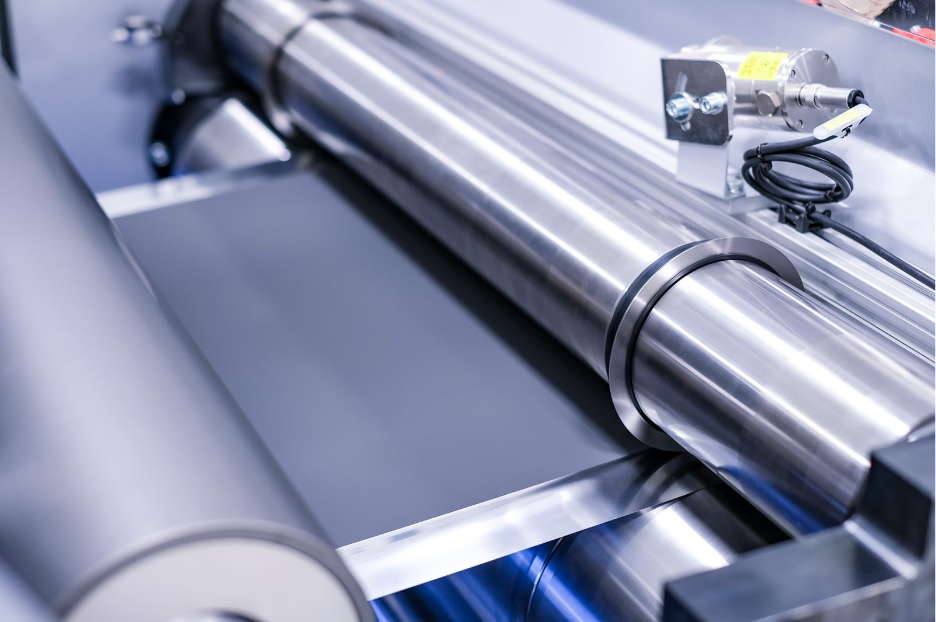
Before a battery cell can be assembled, manufacturers must produce its electrodes. That means applying consistent coatings to metal foil, a process that can require considerable energy and equipment space.
Christoph Leyens, director of the Fraunhofer Institute for Material and Beam Technology IWS and a materials science and engineering professor at TU Dresden, focuses on the production of battery electrodes.

“We are not using a slurry that we are applying on the copper or the aluminum foils, but we are using dry powders, which only contain 1% of a binder. And this binder is a PTFE [polytetrafluoroethylene] binder, which is state-of-the-art,” Leyens said.
This dry coating process is called DRYtraec.
Leyens said the process feeds material between rollers moving at different speeds. The resulting shear causes the binder to form fine fibers that hold the powder particles together, creating a structure he compared to a spiderweb. The material is then applied to the foil.
Eliminating the wet coating step also removes the need to dry and recover the solvents used in that process, Leyens said.
“Now this process saves you a lot of energy because you do not have to dry out the toxic solvents,” he said.
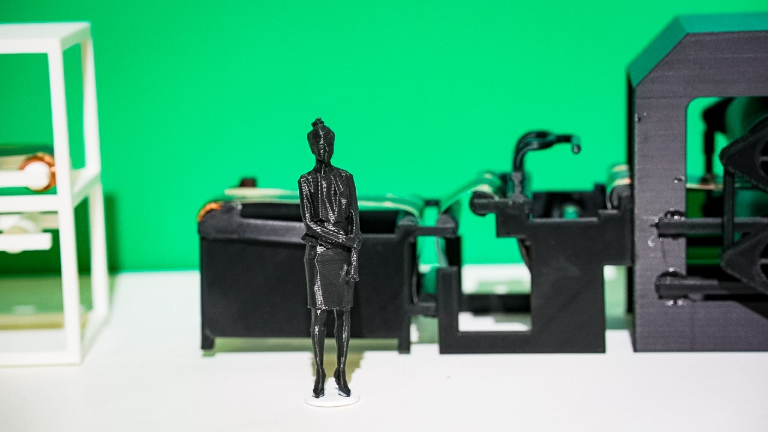
The change also reduces equipment space. Leyens described a dry coating system about 20 meters long, or roughly 66 feet, compared with a conventional system about 120 meters long, or roughly 394 feet. Much of that difference comes from removing the long drying line.
After coating, the material still undergoes calendering, a rolling process that adjusts its thickness and density. Leyens said the overall process can accommodate different production widths and material formulations, with lithium-ion technology serving as a baseline and research extending to areas such as lithium-sulfur and solid-state batteries.
Fraunhofer can also work with a company’s proprietary materials. Customers provide powders, and researchers develop the coating and produce pouch cells that the company can test itself or have Fraunhofer evaluate.
Leyens said Fraunhofer has licensed its dry coating technology to a major European automotive manufacturer. That customer has conducted initial trials in a prototype manufacturing facility and plans to move toward production, he said.
“You can easily scale it up from small to large,” Leyens said.
Electrolyte Filling
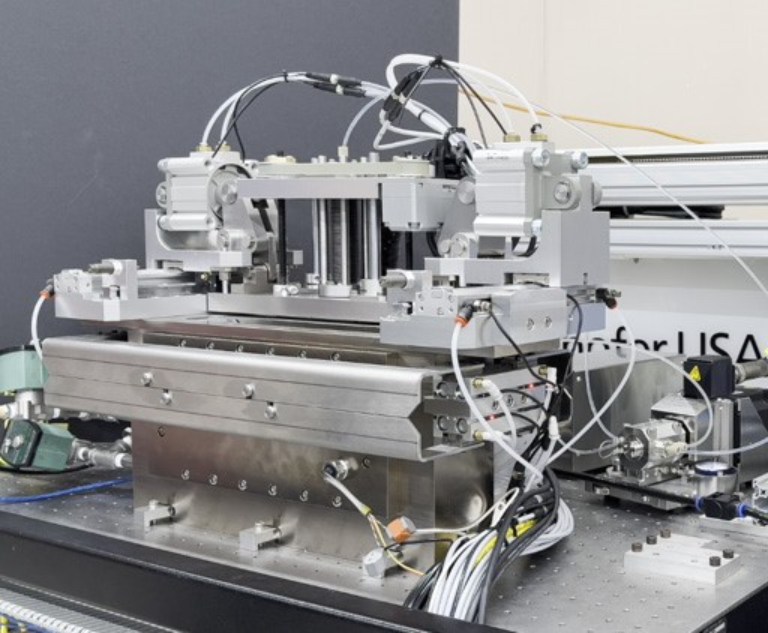
Once those electrodes are assembled with the cell’s other internal components, manufacturers face another challenge: introducing liquid electrolyte and ensuring it reaches the pores within those structures.
Foelke Purr, a transatlantic project coordinator and research scientist at Fraunhofer USA explained that electrolyte filling requires more than delivering the correct volume.
“What we did first is to really get an understanding of what makes it so difficult because it sounds easy,” Purr said.
“In the battery of your cell phone, you would need only five milliliters of liquid electrolyte, which sounds very easy. But in the end, what is not so easy is that a battery consists of very porous structures with high density. You have to make sure that the liquid electrolyte really saturates all these little pores. And that makes it very tricky.”
Achieving consistent saturation becomes more difficult when manufacturers frequently change products, she said.
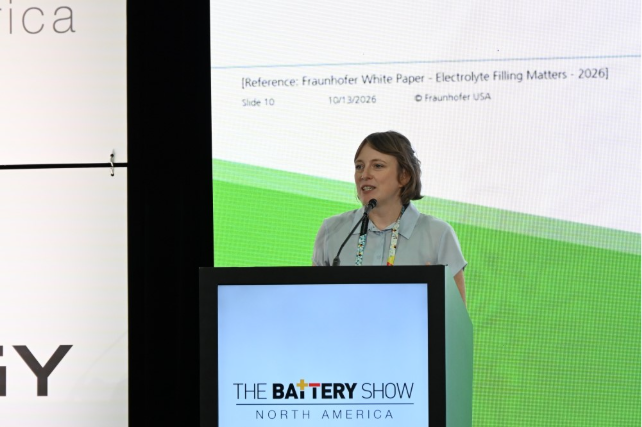
A factory producing the same battery at high volume can optimize its process around that product. Smaller operations serving specialized markets may need to adjust repeatedly as cell designs change. Starting over with each product can consume time and generate scrap. Fraunhofer USA’s approach uses a modular production platform with controlled microenvironments. The smaller setup allows researchers to study and adjust the process under industrial production conditions without relying on a full-scale machine, Purr said. Additional modules can increase production capacity.
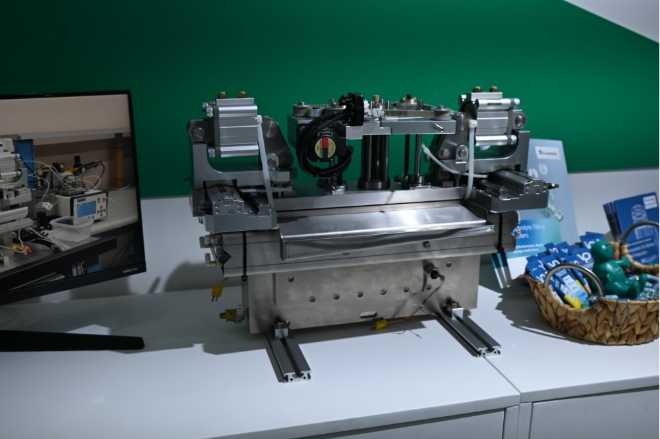
“We can understand the process much better without working on a huge machine,” Purr said.
That flexibility is intended to support faster ramp-up and more precise control as manufacturers move between products. It also provides a way to investigate a difficult production step before committing to a larger system.
AI-Assisted Weld Inspection
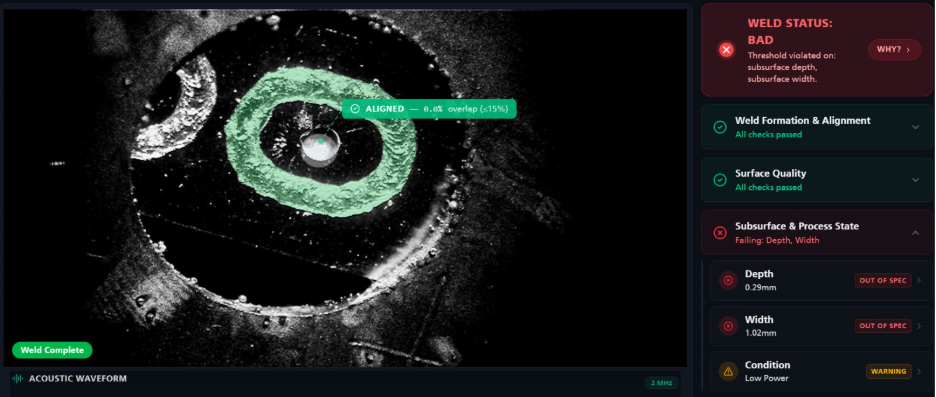
Further along the production process, individual cells must be connected into a module. At this stage, a single poor weld can undermine all the work that came before it.
Arkan Abdulkadir, technical manager at Fraunhofer USA’s laser division in Plymouth, Michigan, works with manufacturers to connect individual battery cells into modules. Laser welding uses focused light energy to melt and join materials quickly, creating the connections that allow cells to function as a larger unit.
The consequences of a defective connection can reach well beyond the weld itself. Abdulkadir described a battery stack containing 1,000 welds: If one fails to meet quality requirements, the module may need to be reworked after much of its assembly is already complete.
Fraunhofer USA’s approach combines sensor data with an internally developed algorithm to predict weld quality. The system can draw on acoustic sensors, a high-speed camera and a 3D scanner, with colleagues in Maryland contributing to the algorithm’s development.
One of its distinguishing features is sound.
“Not many people utilize that acoustic signature of a bad or good weld to determine the weld quality,” Abdulkadir said. “And we’re trying to do a new approach here and utilize that input.”
For manufacturers, however, adding more information is useful only if operators can act on it.
Abdulkadir said automotive companies have described frustration with AI systems that flag too many parts as defective. Under production pressure, workers who believe a part is acceptable may stop trusting the system or turn it off.
Depending on the application, a manufacturer could incorporate all three sensing methods or start with one, Abdulkadir said. Researchers would help establish welding parameters, collect the signatures of good and bad welds and develop the model for that process.
“If you implement this type of solution, this is a very straightforward, very simple signal that would tell you immediately if the weld is good or bad, very reliably,” Abdulkadir added.
The goal is to make inspection useful at the point where a problem occurs, before a questionable connection moves further through production.
Bridging the Lab and the Factory Floor
Across the interviews, each researcher returned to the distance between demonstrating a technology and making it work in industry.
“We connect academic research with industrial application,” Leyens said. “Our DNA is to help industry innovate.”
A researcher may concentrate on improving a material’s properties, while a manufacturer needs to know whether it can run through a production line. Fraunhofer’s work brings those questions together, Leyens said, drawing on researchers with academic and industrial experience.
Moving that research into production also requires workers who understand the processes.
Purr described a training approach for the new battery technology workforce organized like a transit map, with different lines representing subject areas and individual stops representing training opportunities. Participants can move between topics and choose different depths of instruction based on their roles.
“The U.S. has an incredible research environment when it comes to battery development. There is Harvard. There is MIT. But what graduates learn there is mostly lab-based work,” Purr said.
“When it comes to production, that’s a different story. We don’t only have academics, but we have people who work on the shop floor. So, you really need to have an understanding for production.”
The aim is to address gaps between laboratory knowledge and production responsibilities. A quality manager, for example, needs to understand battery technology alongside relevant safety concerns and regulations. Shop floor employees need instruction suited to the processes they operate. Purr said the approach can combine independent online learning with hands-on experience.
This holistic approach, combining research, application in industry, and workforce readiness, is how Fraunhofer operates, Zarras said.
“I believe that all technologies require people, even AI. We need to have people that understand that. There’s starting to be conversations not just around, ‘Hey, here’s a new battery, it holds more power or holds more charge for longer.’ It’s also, ‘How are we going to make it? How do we get the people ready to make it? What infrastructure do we need?’”
Final Thoughts
For researchers and manufacturers alike showcasing at The Battery Show, the call to action was clear: Get the work out of the lab, show what it can do and build the relationships needed to move it forward. A demonstration can spark interest, but sustained collaboration turns that interest into trials, refinements and applications on the factory floor.
Fraunhofer’s capabilities — from dry electrode coating and electrolyte filling to weld inspection and workforce training — show how those conversations can become practical collaborations. Learn more at www.fraunhofer.org and follow Fraunhofer USA on LinkedIn at linkedin.com/company/fraunhofer-usa.
Dennis Burck is Automation Alley's Digital Content Editor, responsible for the organization's content strategy and development. Dennis is a seasoned media-savvy professional who builds relationships with Automation Alley members and partners to create the most relevant digital transformation stories.