


Power transformer production involves a large volume of copper slabs produced in series, across hundreds of shapes, sizes, and designs, and each individual piece needs to be identified on its own. With so many similar-looking parts moving between stations, part level traceability is essential to keep the right copper on the right path without slowdowns or rechecks.
Paper labels were used to identify parts, but they often proved insufficient for copper slabs that were frequently handled and moved. Over time, labels could detach, tear, or become unreadable during routine material flow, which forced manual checks and slowed the line whenever identity became uncertain.
Matrix codes were also tested, but they did not deliver reliable readability across the full variety of copper slab geometries. The reflective copper surface made consistent reading difficult, especially when the available marking area was small or the code had to be placed on a curved or angled section. As a result, read rates were low and consistency was harder to maintain.
To address both issues, Siemens Energy uses Cosmodot’s CDOT code for direct part marking on copper slabs. This makes each part identifiable throughout in-plant movement and enables verification of the same pieces after they are sent to suppliers for nickel plating and returned to the factory for assembly.
Streamlining In-Plant Identification Without Added Operator Steps
Copper slabs move constantly between stations, staging areas, and assembly points, often in parallel batches and with high variety. When identification depended on labels, any missing or damaged label could trigger manual checks and slowdowns just to confirm which part was which.
The CDOT-based approach replaces fragile identifiers with on-part identity. In Siemens Energy factories, copper slabs are marked by an automated laser marking station installed on-site. The key detail is that the station is built for variety, not for one ideal geometry. It recognizes incoming part shapes and places the code where it can be read reliably. That includes very small surfaces and curved outer surfaces that are usually avoided because they are difficult to mark consistently at speed.
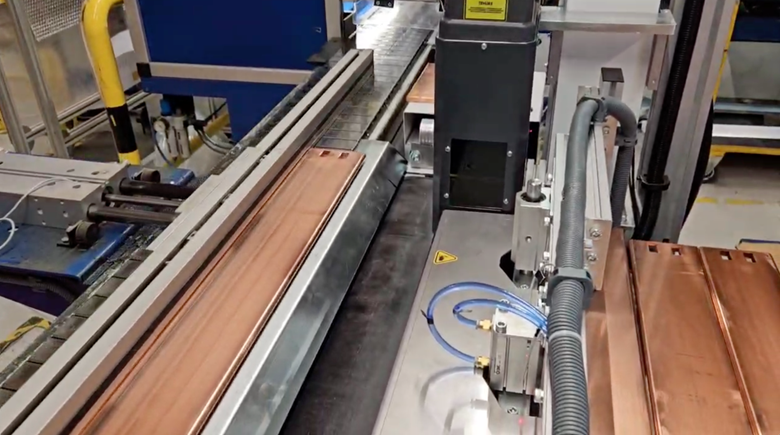
Once the CDOT code is on the part, readers positioned at relevant stations capture the code as the copper moves. This creates a continuous digital trail without adding manual workload. Instead of treating identification as paperwork attached to the part, the identity becomes part of the part itself, stable through handling, staging, and routine shop floor wear.
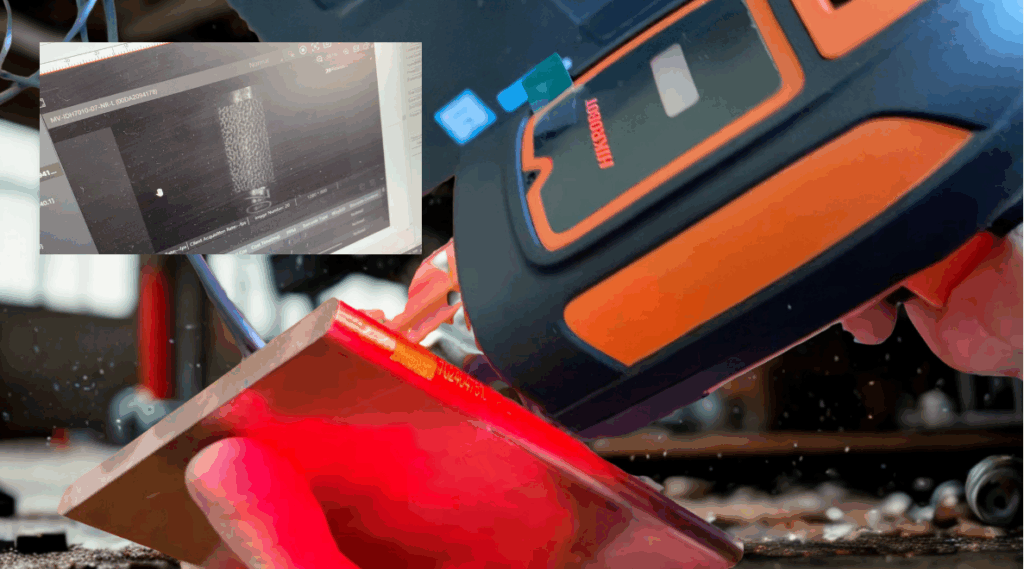
The operational value is straightforward. Parts stay identifiable, manual checks drop, and copper can move through the line with fewer interruptions and less time spent verifying or resorting.
Reusable Identification Through Nickel Plating and Supplier Return
In many production flows, certain copper slabs go through an external nickel plating step before they return to the factory for the next operations and final assembly. That handoff adds a simple but important requirement: the same physical part needs to remain identifiable before it leaves, while it is processed, and again when it comes back.
With traditional 2D matrix codes, trials showed that plating often reduced readability on these parts. Once the copper was nickel-coated, the mark could become hard to read, which made part level verification on return unreliable and increased the risk of extra checks, delays, or uncertainty during receiving and reintegration.
Cosmodot’s CDOT code addresses this by keeping the same code reusable after plating. A copper slab is marked once on bare copper, then scanned again after nickel plating and still resolves to the same unique identity.
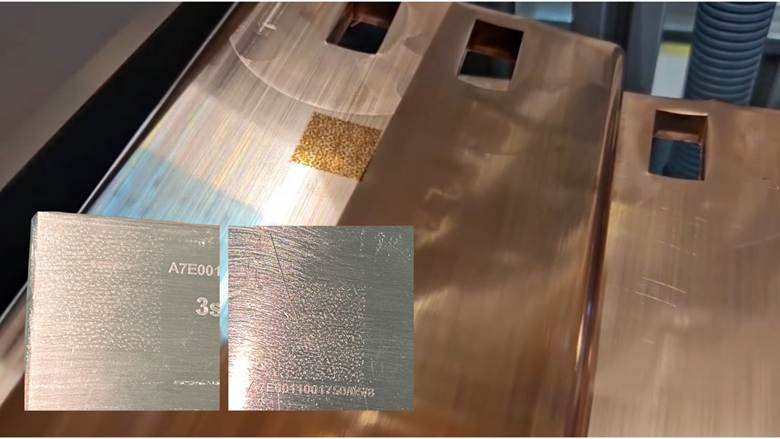
This enables fast verification at receiving, keeps pre-plating and post-plating records linked under one unique ID, and reduces mix ups when similar plated parts come back in groups. It also strengthens supply chain traceability by ensuring the right copper can be confirmed and matched to the right history before it reenters assembly.
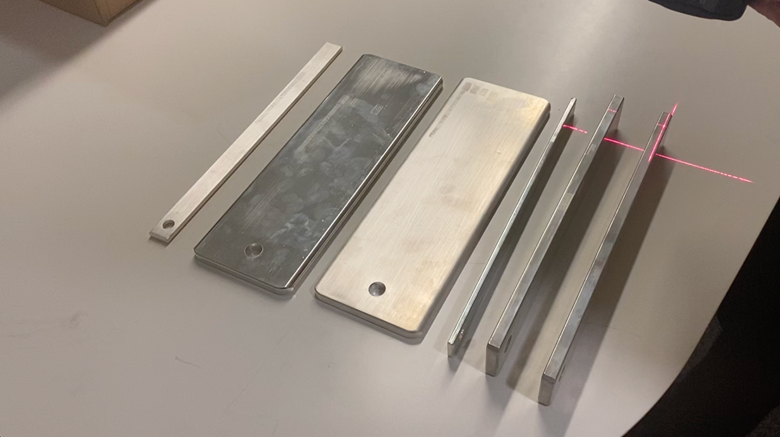
Barcode reader scanning a CDOT Code on a nickel plated copper slab.
Conclusion
Reusable direct part marking on copper slabs gives Siemens Energy a practical way to keep each part identifiable from first handling through final assembly, even when parts leave the factory for supplier nickel plating and return later. In these implementations, an automated laser station applies Cosmodot’s CDOT code along with human-readable markings, so operators can recognize the part visually while scanners maintain part level traceability in the background.
The result is faster verification at receiving, cleaner linkage between process steps, and fewer mix ups when similar parts move in parallel. Most importantly, it helps Siemens Energy confirm that the same high value copper slabs that left the plant are the ones that come back, and that they match the correct production history before they reenter assembly.
The impact is measurable. Clearer part identity reduces time lost to manual checks and investigations, supports tighter quality tracking and faster root cause analysis, and protects against avoidable losses of valuable copper through misrouting or mismatch. At plant scale, these improvements translate into substantial annual savings through higher throughput, lower handling effort, and fewer operational disruptions.
About Cosmodot
Cosmodot invented CDOT Code, a new code symbology built specifically for direct part marking. It stands out for being survivable, high in data capacity, and reusable, so the same permanent ID can be read reliably even when parts face challenging surfaces or downstream processes. CDOT acts as a practical cure for a large market need, and Cosmodot has already solved extremely challenging, real-world identification cases for major manufacturers by enabling reliable part level tracking at a scale across industries including aerospace, automotive, defense, iron and steel, casting, forging, electronics, and semiconductors, by reducing lost identity events, improving process continuity, and strengthening traceability in harsh production environments. Cosmodot continues to expand globally, helping manufacturers integrate resilient identification into existing lines and achieve high impact productivity gains and savings.
Learn more about the CDOT Code here.
For additional information on CDOT demos, project implementations, and pricing, contact info@thecosmodot.com.
Serra Tuzcuoglu is the Co-Founder and CEO of Cosmodot and the Co-Inventor of the CDOT AI Code, an AI-powered part identification system designed for industrial parts and products. She is also the creator of the CTRACE methodology, which enables live closed-loop traceability across the factory floor. She brings a strong background in product strategy and industrial innovation and holds multiple patents and publications. Her work has advanced traceability in industries such as aerospace, automotive, defense, iron and steel, casting, forging, electronics, and semiconductors by enabling part-level tracking at a scale where conventional 2D codes fall short in data capture. She has expanded Cosmodot’s operations globally, offering manufacturers a transformative tool for resilient part identification and measurable productivity gains in the world’s toughest factory environments.